Choosing a phonics programme can feel overwhelming. A quick online search reveals hundreds of workbooks, apps, videos, flashcards, subscriptions and programmes—all claiming to help children learn to read.
So how do you know which one is right for your child?
The answer isn’t found in colourful worksheets or clever marketing.
A great phonics programme is built on how children actually learn to read.
As a qualified primary teacher, I’ve worked with children who have thrived with structured phonics teaching and others who have struggled because important foundations were missed. The difference is rarely about ability—it is usually about the quality, structure and consistency of the teaching.
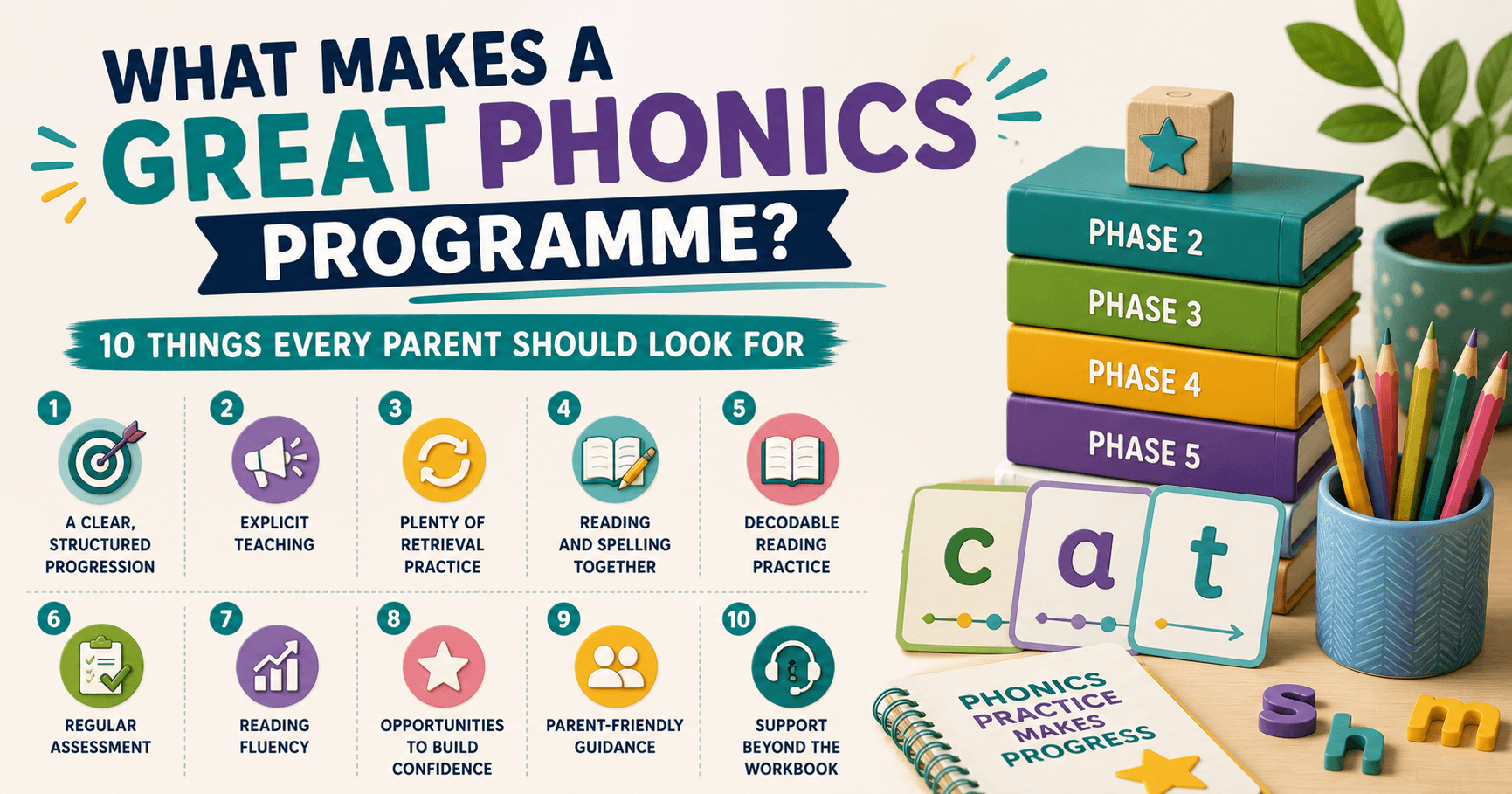
Here are 10 things every parent should look for when choosing a phonics programme.
1. A Clear, Structured Progression
One of the biggest mistakes phonics programmes make is introducing sounds in a random order. Children need learning that follows a carefully planned sequence. A strong programme introduces new knowledge gradually while constantly revisiting previous learning. Each lesson should build naturally on the one before it. Children should never feel as though they have suddenly skipped ahead.
Ask yourself:
Does the programme follow recognised phonics phases?
Is learning introduced in manageable steps?
Can I clearly see what comes next?
A structured pathway builds confidence because children experience success at every stage.
2. Explicit Teaching
Children should not be expected to discover phonics rules for themselves. Good phonics teaching is explicit. Children need clear explanations, demonstrations and guided practice before working independently. The best lessons follow a simple pattern:
Teach
↓
Model
↓
Practise Together
↓
Practise Independently
This gradual release helps children become confident and independent learners.
3. Plenty of Retrieval Practice
One lesson is rarely enough. Children naturally forget unless they revisit learning regularly. Effective phonics programmes include opportunities to:
review previous sounds
revisit tricky words
reread familiar texts
recall spelling patterns
Retrieval strengthens memory and makes future learning easier. Little and often is far more effective than learning lots of new sounds without revision.
4. Reading and Spelling Together
Some resources focus almost entirely on reading. Others only provide spelling activities. Strong phonics programmes teach both because they reinforce one another. Children should regularly:
blend to read
segment to spell
read sentences
write sentences
Reading and writing develop side by side.
5. Decodable Reading Practice
Children need reading practice that match the sounds they already know. If a reading book/excerpt contains many unfamiliar spellings, children often begin guessing. Decodable texts allow children to apply their phonics knowledge successfully. Success builds confidence. Confidence encourages more reading.
6. Regular Assessment
Assessment isn’t about passing or failing. It’s about understanding where a child is now and deciding what to teach next. A good phonics programme should include opportunities to identify:
secure sounds
gaps in learning
blending confidence
spelling accuracy
fluency
Without assessment, it’s easy to spend time practising the wrong things.
7. Reading Fluency
Being able to sound out every word isn’t the final goal. Children also need to develop fluency. Fluent readers:
recognise words automatically
read smoothly
use expression
understand punctuation
focus on meaning
Fluency develops through repeated reading and carefully chosen practice.
8. Opportunities to Build Confidence
Learning to read is emotional as well as academic. Children need to experience success regularly. The best programmes:
celebrate effort
build resilience
avoid overwhelming children
progress at an appropriate pace
Confidence often grows when children realise: “I can do this.”
9. Parent-Friendly Guidance
Not every parent has a teaching background. A quality programme should explain:
what children are learning
why it matters
how to help at home
common mistakes to avoid
Parents shouldn’t feel they need specialist training to support their child. The programme should guide them.
10. Support Beyond the Workbook
Worksheets alone don’t teach children to read. The strongest programmes provide additional support through:
teacher guidance
assessment
practical advice
demonstrations
opportunities to ask questions
Families often feel more confident when they know help is available if they need it.
Red Flags to Watch Out For
Not every phonics resource is created equally. Be cautious if a programme:
❌ introduces too many sounds too quickly
❌ relies heavily on guessing from pictures
❌ doesn’t revisit previous learning
❌ has no clear progression
❌ doesn’t include reading practice
❌ focuses only on worksheets
❌ provides no assessment
❌ expects children to memorise words instead of decoding them
Why Small Steps Matter
One of the biggest misconceptions in phonics is that faster is better. It isn’t. Children who develop secure foundations usually become stronger readers than children who rush through every phase. Good phonics teaching values:
mastery
confidence
repetition
understanding
over speed. Learning should feel achievable.
How Quality First Education Supports Children
At Quality First Education, our phonics resources have been designed around these principles. Our programmes include:
✔ Structured progression from Phase 2 to Phase 5
✔ Explicit teaching
✔ Retrieval practice
✔ Reading and spelling
✔ Sentence reading
✔ Sentence writing
✔ Fluency activities
✔ Regular assessment
✔ Parent guidance
✔ Confidence-building activities
Everything is carefully sequenced so children develop secure foundations before moving on.
Which Option Is Right for Your Child?
Every family learns differently. That’s why we offer different ways to support your child’s reading journey.
Printable Phonics Workbooks
Ideal for families who:
prefer flexible learning
enjoy practising at home
want structured daily activities
like learning at their own pace
Each workbook follows the same progression used in our teaching and includes reading, spelling, writing and retrieval activities.
Live Online Phonics Programmes
Some children benefit from teacher guidance, interaction and regular encouragement.
Our online lessons include:
25-minute sessions
qualified primary teacher
maximum of 10 children
interactive activities
confidence-building teaching
carefully structured progression
Children receive direct support while learning alongside others at a similar stage.
One-to-One Phonics Consultation
Not sure which option is best?
Book a personalised consultation where we’ll discuss:
your child’s current reading level
assessment results
strengths
areas for development
recommended next steps
whether a workbook, live programme or combination of both would be most beneficial
Start with the Right Foundation
If you’re unsure where your child is currently working, begin with our FREE QFE Phonics Assessment.
It will help you identify:
your child’s phonics phase
strengths
sounds to revisit
recommended next steps
From there, you can choose the support that best matches your child’s needs.
A great phonics programme isn’t the one with the brightest colours or the longest list of activities. It’s the one that helps children build secure foundations, develop confidence and enjoy reading. When teaching is structured, supportive and matched to a child’s current stage, remarkable progress can happen. Because learning to read isn’t about racing through phonics. It’s about giving children the skills they need to become confident, independent readers for life.
Ready to Find the Right Phonics Support?
Download the QFE Phonics Assessment
Assess your child’s phonics skills at home, identify their current stage and discover exactly where to start.
Download the phonics assessment workbook
Explore Our Phonics Workbooks
Structured, printable workbooks carefully matched to each phonics phase.
Browse the Workbook Collection
Join a Live Online Phonics Programme
Teacher-led, small-group lessons designed to build confident, independent readers.
Book a One-to-One Phonics Consultation
Receive personalised advice and recommendations tailored to your child’s individual learning needs.