One of the questions I hear most often from parents is:
“What phonics phase should my child be on?”
It’s a perfectly understandable question. Schools talk about Phase 2, Phase 3, Phase 4 and Phase 5, but unless you’re familiar with the phonics programme your child is following, these stages can feel confusing.
The truth is, there isn’t a race to reach the highest phase as quickly as possible.
The goal is for children to become secure, confident readers by mastering each stage before moving on.
In this guide, we’ll explain what each phonics phase involves, the skills children develop and how to recognise when they’re ready for the next step.
What Are Phonics Phases?
Phonics is taught in carefully planned stages, often called phases. Each phase introduces new sounds and skills while continually revisiting previous learning. Children don’t simply learn more sounds—they also develop their ability to:
recognise graphemes
blend sounds to read words
segment words for spelling
read with increasing fluency
spell more accurately
build confidence as readers
Strong foundations at each phase make later reading much easier.
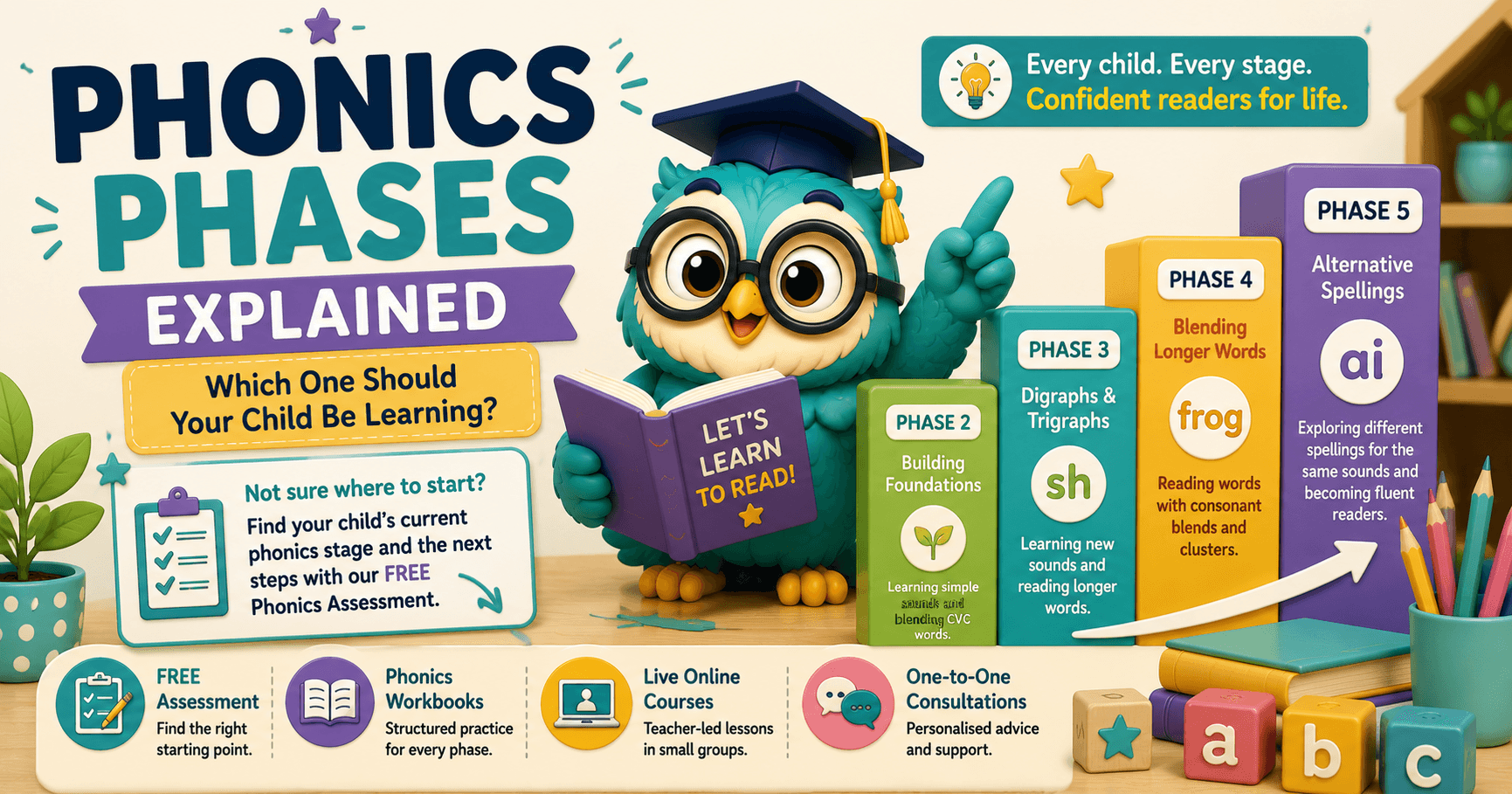
Phase 2
Building the Foundations
Phase 2 is where children begin learning that letters represent sounds. They are introduced to their first set of letter sounds and start blending simple words.
Children learn to:
recognise single letter sounds
blend simple CVC words
segment simple words for spelling
read simple captions
begin writing simple words
Typical words
cat
dog
pin
sun
hat
jam
Your child may be ready for Phase 3 if they can:
✔ recognise most Phase 2 sounds
✔ blend simple CVC words independently
✔ segment simple words when spelling
✔ read short captions with confidence
Phase 3
Introducing Digraphs and Trigraphs
Children now discover that sometimes two or three letters work together to make one sound. Examples include:
sh
ch
th
ai
ee
oa
igh
Reading suddenly becomes much more exciting because children can decode a wider range of words.
Children learn to:
recognise digraphs
recognise trigraphs
read longer words
spell using new graphemes
learn more tricky words
Example words
sheep
train
night
boat
rain
queen
Your child may be ready for Phase 4 if they can:
✔ recognise Phase 3 graphemes automatically
✔ blend words containing digraphs
✔ spell simple words confidently
✔ read short books with increasing independence
Phase 4
Blending Longer Words
Interestingly, Phase 4 introduces very few new sounds. Instead, children practise applying everything they have already learned. The focus shifts towards words containing adjacent consonants (often called consonant blends or clusters).
Examples include:
frog
clap
tent
milk
jump
twist
Children learn to:
read CCVC words
read CVCC words
blend longer words
spell words with consonant clusters
increase reading fluency
Your child may be ready for Phase 5 if they can:
✔ confidently blend longer words
✔ recognise consonant blends
✔ read unfamiliar words independently
✔ spell accurately using previous learning
Phase 5
Becoming Flexible Readers
Phase 5 is often the longest stage. Children discover that the same sound can be represented in different ways. For example:
The /ai/ sound can be written as:
ai
ay
a-e
The /ee/ sound can appear as:
ee
ea
e-e
y
Children also learn that some graphemes represent more than one sound. For example:
ow
can sound different in:
snow
and
cow
This stage helps children become much more flexible readers and spellers.
Children learn to:
alternative spellings
alternative pronunciations
more complex words
reading fluency
spelling accuracy
Example words
rainbow
beach
snow
cloud
blue
cake
Why Children Don’t All Move Through the Phases at the Same Speed
Every child develops differently. Some children master blending very quickly. Others need longer to consolidate earlier sounds. This is completely normal. Moving through the phases too quickly can actually make reading harder later on.
Children benefit from:
retrieval
repetition
revisiting previous sounds
practising reading
practising spelling
Confidence grows through success—not speed.
How Can I Tell If My Child Is in the Right Phase?
Rather than focusing on age alone, ask yourself:
Can my child…
✔ recognise the sounds confidently?
✔ blend words without guessing?
✔ spell using the sounds they know?
✔ read unfamiliar words?
✔ read simple sentences fluently?
If the answer is “not yet,” they may simply need a little more consolidation before moving on.
Not Sure Which Phase Your Child Is Working Within?
One of the biggest challenges for parents is knowing where to start.
That’s exactly why we’ve created the FREE QFE Phonics Assessment.
It helps identify:
your child’s current phonics phase
strengths
gaps in learning
sounds to revisit
recommended next steps
Instead of guessing, you’ll have a much clearer understanding of exactly where your child is on their reading journey.
Looking for the Right Support?
Once you know your child’s current stage, choosing the right support becomes much easier.
Printable Phonics Workbooks
Our carefully structured workbooks match each phonics phase and include:
sound practice
blending
segmenting
reading
spelling
sentence writing
retrieval activities
parent guidance
Perfect for flexible learning at home.
Live Online Phonics Programmes
Some children benefit from teacher guidance and regular encouragement.
Our small-group online lessons provide:
qualified teacher-led teaching
25-minute sessions
maximum of 10 children
interactive activities
reading
spelling
confidence building
Lessons are carefully matched to each child’s current phonics stage.
One-to-One Phonics Consultation
Not every child follows the same path.
If you’d like personalised advice, you can book a one-to-one consultation where we’ll discuss:
your child’s assessment
current reading level
areas of strength
any learning gaps
recommended next steps
whether a workbook, programme or both would best support their progress
Sometimes, a personalised plan is all a family needs to move forward with confidence.
Every confident reader starts with secure foundations. The goal isn’t to finish Phase 5 as quickly as possible. The goal is to build strong phonics knowledge that allows children to:
decode confidently
read fluently
spell accurately
enjoy reading
Every sound learned.
Every word blended.
Every sentence read.
Brings your child one step closer to becoming an independent reader.
And remember…
The right phase is the one where your child feels successful—not the one someone else thinks they should be on.
Ready to Find Your Child’s Current Phonics Phase?
Download the QFE Phonics Assessment
Assess your child’s phonics skills at home, identify their current stage and discover exactly where to start.
Download the phonics assessment workbook
Explore Our Phonics Workbooks
Structured, printable workbooks carefully matched to each phonics phase.
Browse the Workbook Collection
Join a Live Online Phonics Programme
Teacher-led, small-group lessons designed to build confident, independent readers.
Book a One-to-One Phonics Consultation
Receive personalised guidance and recommendations tailored to your child’s needs.