Every year on 8 September, International Literacy Day draws attention to something that can easily be taken for granted: the ability to read and write. For many of us, reading is woven so naturally into everyday life that we barely notice how often we rely on it. We read messages. We follow recipes. We understand signs. We search for information. We complete forms. We read instructions, stories, news, maps, labels and websites.
For a child, however, reading begins with something much smaller. A sound. A letter. A word slowly blended together. A sentence read independently for the first time. These early moments may seem simple, but they are building a skill that can influence almost every area of a child's future. Literacy is not simply another school subject. It provides access to education, information, communication, independence and participation in society. That is why International Literacy Day matters. And it is why giving children secure foundations in reading matters too.
What Is International Literacy Day?
International Literacy Day was established by UNESCO and has been observed annually since 1967. Its purpose is to highlight the importance of literacy as a matter of dignity and human rights while drawing attention to the continuing challenge of literacy around the world. Despite enormous progress in education, literacy is still far from universal. UNESCO estimates that 739 million adults worldwide lack basic literacy skills, while large numbers of children and young people still do not achieve minimum proficiency in reading. Behind statistics like these are individual lives. A person who struggles to read may find it more difficult to access education, understand health information, navigate employment, use services or participate fully in their community. For children, the consequences can begin much earlier. When reading is difficult, accessing the rest of the curriculum can become increasingly difficult too.
Reading Is a Gateway to Learning
Think about what happens as children progress through education. In the early stages, much of their attention is devoted to learning to read. Gradually, something changes. They increasingly begin to read to learn. A child may need to read:
a maths problem
instructions for a science experiment
information about Ancient Egypt
a geography textbook
a computer programme
a museum display
a research article
an examination question
Reading becomes the route through which much other knowledge is accessed. This means difficulty with reading does not necessarily remain confined to English or literacy lessons. It can affect learning across subjects. A child might understand multiplication perfectly when a question is explained aloud but struggle with a written word problem. They may be fascinated by space but unable to independently access a book about planets. They may have wonderful ideas for a project but struggle to research them. Reading ability influences access. That is one reason establishing secure foundations early can be so powerful.
Learning to Read Is Not the Same as Learning to Speak
Most children acquire spoken language through interaction with the people around them. Reading is different. Written language is a human invention, and children need to learn how the written symbols on a page connect with the language they already know. In alphabetic languages such as English, one of the crucial early discoveries is that spoken words can be broken into individual sounds and that written letters and letter combinations represent those sounds. The word cat, for example, can be heard as: /c/ /a/ /t/ . A beginning reader learns to recognise the graphemes representing those sounds and blend them together to read the word. That process can eventually become so automatic that an experienced reader looks at cat and appears to recognise it instantly. But automatic reading develops through learning and practice.
Why Phonics Matters in Early Reading
This is where systematic phonics instruction becomes important. Phonics teaches children the relationship between the sounds in spoken language and the letters or groups of letters used to represent them. Children gradually learn to:
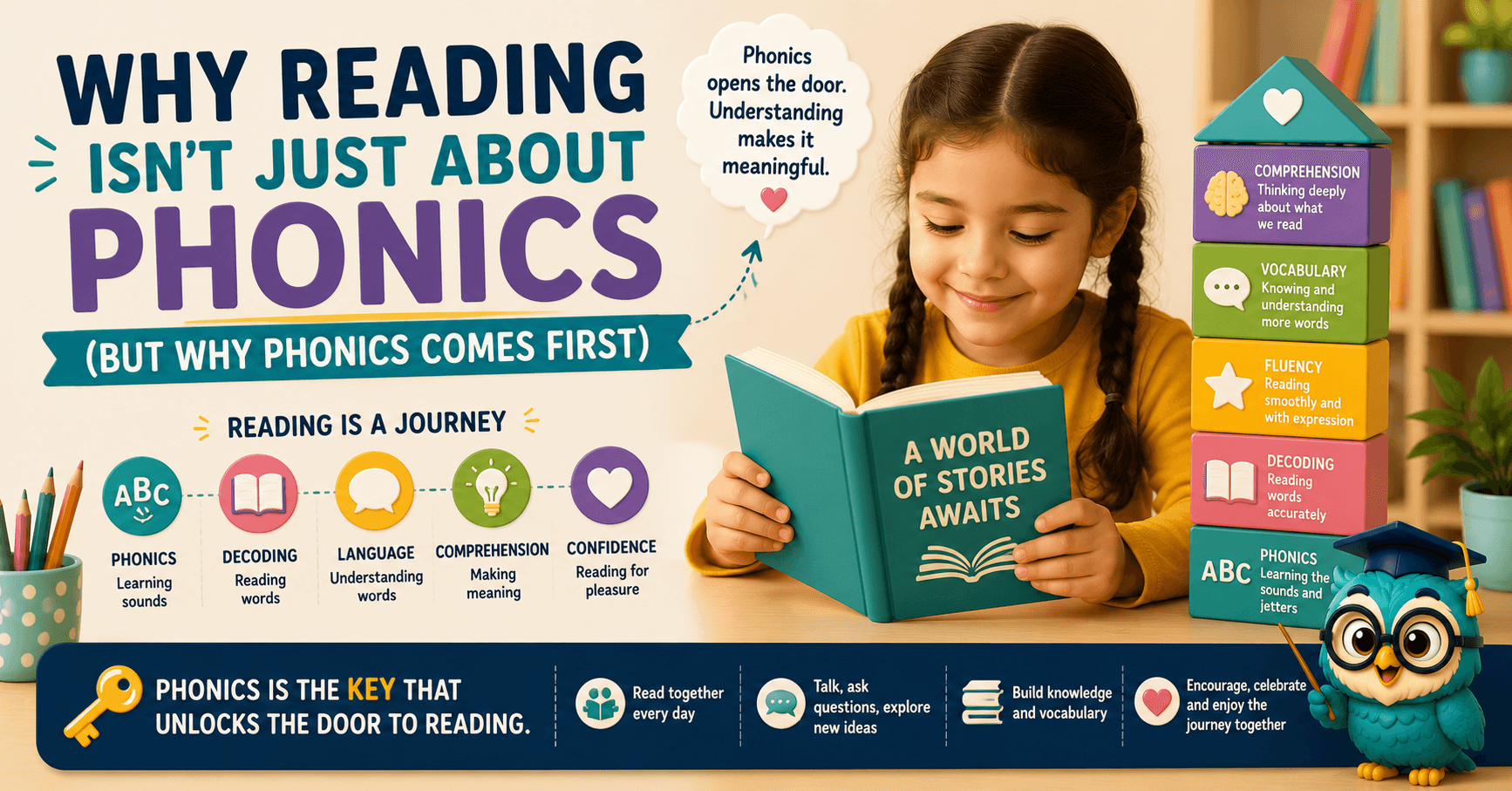
recognise sounds → connect sounds with graphemes → blend sounds → read words → read sentences → develop fluency.
Evidence reviews in England and internationally support explicit, systematic teaching of the alphabetic code as an important component of beginning reading instruction. England's Department for Education continues to describe systematic synthetic phonics as the approach used for teaching early reading in state-funded primary schools. But phonics is not the final destination. It is part of the foundation that helps children reach it.
Reading Is More Than Phonics
A child can successfully decode: The frog jumped into the pond.
But that does not automatically mean they understand:
what a pond is,
what jumped means,
why the frog might have jumped,
what is happening in the sentence,
or how that sentence connects with a larger story.
Successful reading therefore requires more than decoding. Children also develop:
vocabulary
oral language
background knowledge
comprehension
fluency
reasoning
inference
knowledge of sentence structures
This is why reading with children remains important even while they are learning phonics. Phonics helps children access the words. Language and knowledge help them understand what those words mean. The two should work together.
Why Early Foundations Matter
Reading development is cumulative. Later skills build upon earlier ones. A child who is not yet secure recognising common grapheme–phoneme correspondences may need considerable mental effort simply to decode a word. Imagine reading:
The bright green frog jumped quickly across the garden.
An experienced reader processes those words with little conscious effort. A beginning reader may need to identify individual sounds, hold them in working memory, blend them together, recognise the word and then move on to the next one. That requires significant cognitive effort. As decoding becomes more automatic, children can direct more attention towards: meaning, expression, vocabulary and comprehension.
This is one reason fluency matters. Children are not practising phonics simply so they can complete phonics activities. They are developing a system that eventually allows reading to become increasingly efficient.
The Importance of Automaticity
Consider the difference between a child who sees ship and immediately reads it and a child who must slowly process: /sh/ /i/ /p/. The second child may still be reading accurately. That is progress. With repeated successful encounters, however, decoding becomes quicker and more automatic. This is important because working memory is limited. If a large amount of mental capacity is being used to decode every individual word, less is available for thinking about what the text actually means. Fluency therefore acts as an important bridge between word recognition and comprehension. This is also why slow reading should not automatically be treated as bad reading. Accuracy comes first. Speed develops through successful practice.
Repetition Is Part of Learning
Parents sometimes worry when a child appears to have forgotten a sound they learned previously. But forgetting does not necessarily mean something has gone wrong. Memory strengthens through retrieval and repeated use. A child may learn /ai/, recognise it confidently during a lesson and then hesitate when they encounter it several days later. That hesitation provides useful information. The knowledge may need more consolidation. Returning to the sound is not moving backwards. It is strengthening the foundation. Children need repeated opportunities to encounter phonics knowledge in:
individual sounds
words
sentences
books
spelling
writing
Eventually, what once required considerable thought becomes increasingly automatic. Secure learning matters more than racing through a programme.
Reading and Vocabulary Develop Together
Reading also introduces children to language they may not encounter in everyday conversation. A child might rarely hear words such as: enormous, peculiar, exhausted, ancient, investigate, cautiously during ordinary daily interactions. Books create opportunities to encounter them. When adults read aloud, pause to discuss unfamiliar words and talk about stories, children can develop vocabulary beyond the words they use themselves. This becomes increasingly important as children grow. The vocabulary required to understand history, science, geography and literature becomes progressively more sophisticated. Reading widely helps children encounter this language in meaningful contexts.
Knowledge Helps Children Understand What They Read
Comprehension is not simply a generic skill that can be practised independently of knowledge. What we already know influences what we understand. Imagine reading an article about cricket without knowing what a wicket, innings, bowler or over is. You may be able to decode every word perfectly while understanding very little. Children experience the same thing. The more they learn about:
nature
history
science
geography
people
cultures
technology
stories
places
the more knowledge they have available when they encounter those ideas in text. This is another reason education should not become narrowly focused on reading strategies alone. We teach children to read so they can access knowledge and knowledge, in turn, helps them become stronger readers.
Why Reading Aloud Still Matters
Once children begin reading independently, adults sometimes stop reading to them. But reading aloud continues to have enormous value. A child may be capable of independently reading a relatively simple book while being able to understand much richer language when someone else reads it aloud. Reading aloud gives children access to:
sophisticated vocabulary
longer sentences
more complex stories
unfamiliar concepts
humour
emotion
different genres
It also creates something that cannot easily be measured on a reading assessment: shared experience. Talking about a story, laughing together, predicting what might happen and discussing a character's decisions all contribute to a child's relationship with books and language.
Literacy Is Also About Confidence
There is an emotional side to learning to read. Imagine repeatedly being asked to do something that feels difficult while watching other children do it easily. Over time, a child may begin to think: "I'm bad at reading." That belief can become powerful. They may avoid books. They may guess rather than attempt unfamiliar words. They may become anxious when asked to read aloud. They may rush because they want the experience to end. This is why the way adults respond is important. Instead of focusing only on mistakes, notice the process.
"You spotted that digraph."
"You went back and tried again."
"You sounded that word out carefully."
"You remembered that sound from yesterday."
Children need to experience reading as something they can learn, not as a judgement of how clever they are.
Literacy Looks Different Around the World
International Literacy Day also reminds us that literacy exists within different languages, cultures and educational systems. Children around the world learn to read using different writing systems. Some grow up bilingual or multilingual. Some learn in one language at school and speak another at home. For these children, maintaining a home language can be a valuable part of their linguistic and cultural development. Learning English does not require families to abandon the language spoken at home. Rich conversation, storytelling, songs, books and family interactions in a child's home language all contribute to language development. Multilingualism should not automatically be treated as a barrier to literacy. For many children, it is an asset.
Literacy Beyond the Classroom
One of the most useful things families can remember is that literacy does not belong exclusively at a desk. Children encounter meaningful reading everywhere. At the supermarket they can read: labels, prices, signs and shopping lists. While cooking: recipes, measurements and instructions. While travelling: maps, timetables, museum information and place names. At home: books, letters, instructions, games and messages. For worldschooling families, literacy can become part of exploring a new country. Children might:
keep a travel journal
research a destination
read museum displays
learn local vocabulary
compare languages
write postcards
investigate local history
For home educators, this flexibility is particularly valuable. Reading can be explicitly taught while also becoming part of real life.
What Can Parents Do to Support Early Reading?
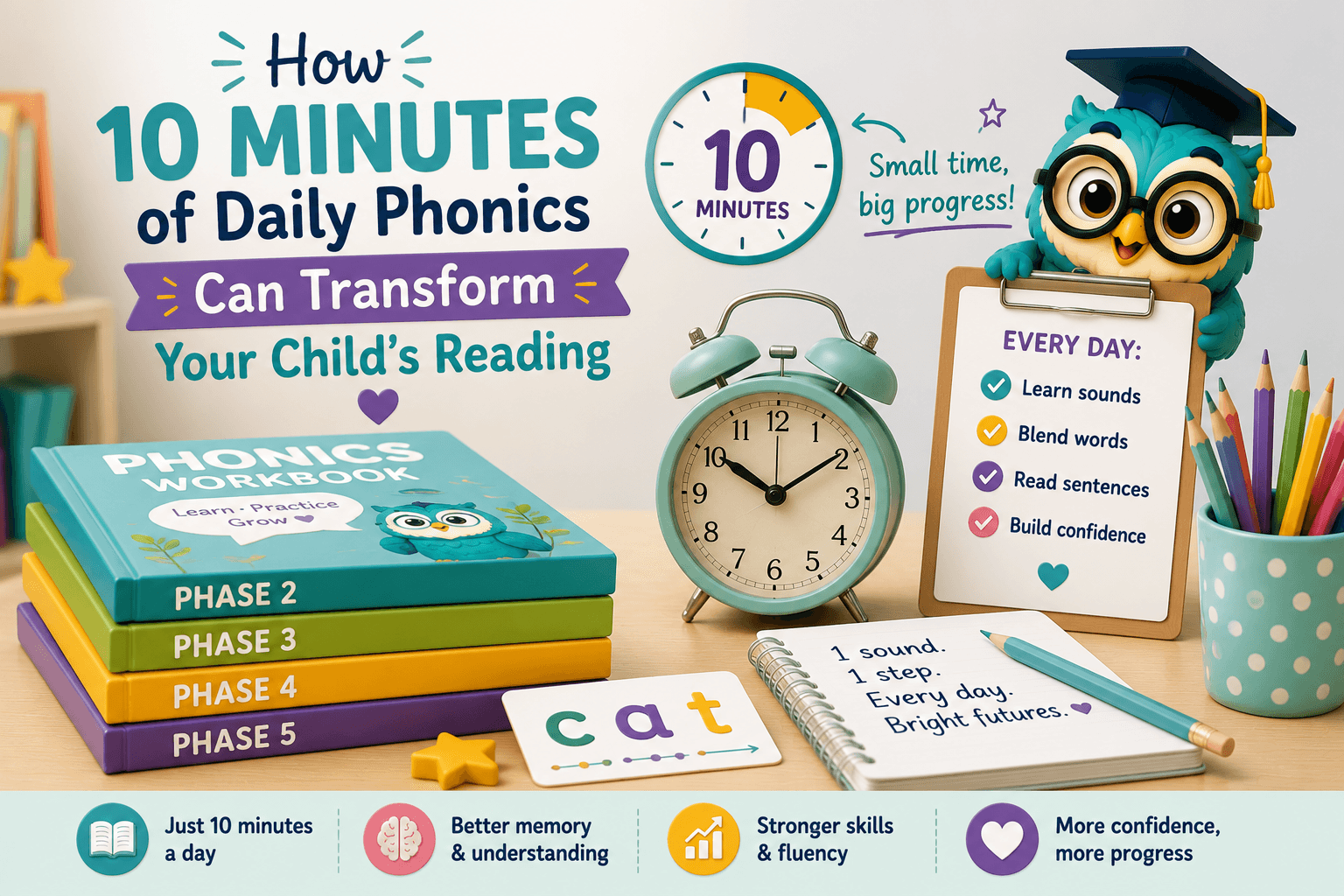
Supporting literacy at home does not require hours of formal teaching. For younger children, short, consistent practice can be extremely effective. You might spend ten minutes:
revisiting known sounds,
practising one new sound,
blending several words,
reading a sentence,
spelling a few words,
or rereading a familiar decodable text.
Then read a story together for enjoyment.
Talk.
Ask questions.
Explain unfamiliar words.
Let your child ask questions too.
And if something is not secure, revisit it.
There is no prize for completing phonics as quickly as possible.
Don't Rush Through Phonics Phases
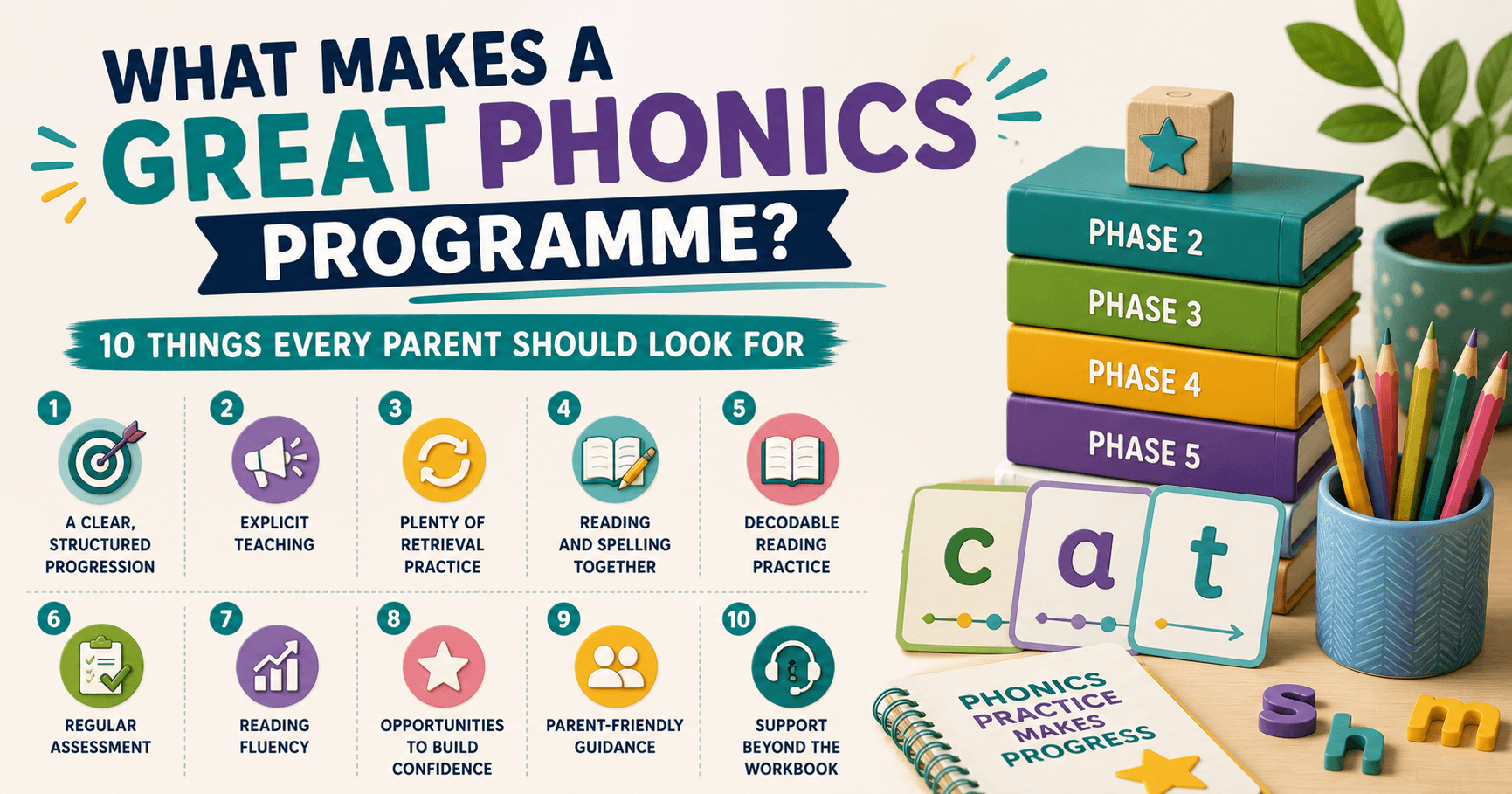
One of the mistakes adults can make is assuming progression always means moving forward. Sometimes progress means staying where you are long enough for learning to become secure. If a child is struggling to blend Phase 2 words confidently, moving rapidly into increasingly complex graphemes may increase cognitive load rather than solve the problem. Likewise, if a child knows individual sounds but struggles to apply them in words, more flashcards alone may not be the answer. The missing skill might be blending. Good assessment therefore asks: What can this child actually do? Not simply: Which phase should they be in because of their age?
Start From the Child, Not the Calendar
Children do not all develop at exactly the same pace. One child may move quickly through early phonics. Another may need far more repetition. A child might have excellent vocabulary but find decoding difficult. Another may decode confidently but struggle to explain what they have read. This is why assessment is valuable. It helps adults identify:
what is secure,
where gaps exist,
what needs revisiting,
and what the next appropriate learning step should be.
The aim should not be to label a child as "behind". It should be to understand where teaching needs to begin.
What If My Child Is Struggling?
First, try to identify the difficulty rather than simply increasing the amount of work. Ask:
Can they recognise the sounds they have been taught?
Can they say the sounds accurately?
Can they blend sounds into words?
Can they segment words for spelling?
Can they read words containing familiar graphemes?
Can they read simple sentences?
Are they accurate but slow?
Do they understand what they have read?
Do they guess from pictures or first letters rather than decoding?
Different difficulties require different support. A child struggling with sound recognition needs something different from a child who knows every sound but cannot blend them together. Assessment should guide teaching.
Literacy Is a Global Issue, but It Begins With Individual Children
International statistics are important because they reveal the scale of literacy challenges. But every statistic represents a person. And every reader begins somewhere. For one child, progress might mean recognising their first letter sound. For another, it is blending three sounds without help. For another, it is reading an entire sentence fluently. For another, it is finally picking up a book voluntarily after believing for years that they "can't read". Those moments matter. Because literacy is not created in one dramatic leap. It develops through thousands of small encounters with sounds, words, books, conversations, knowledge and ideas.
Why Literacy Can Change a Child's Future
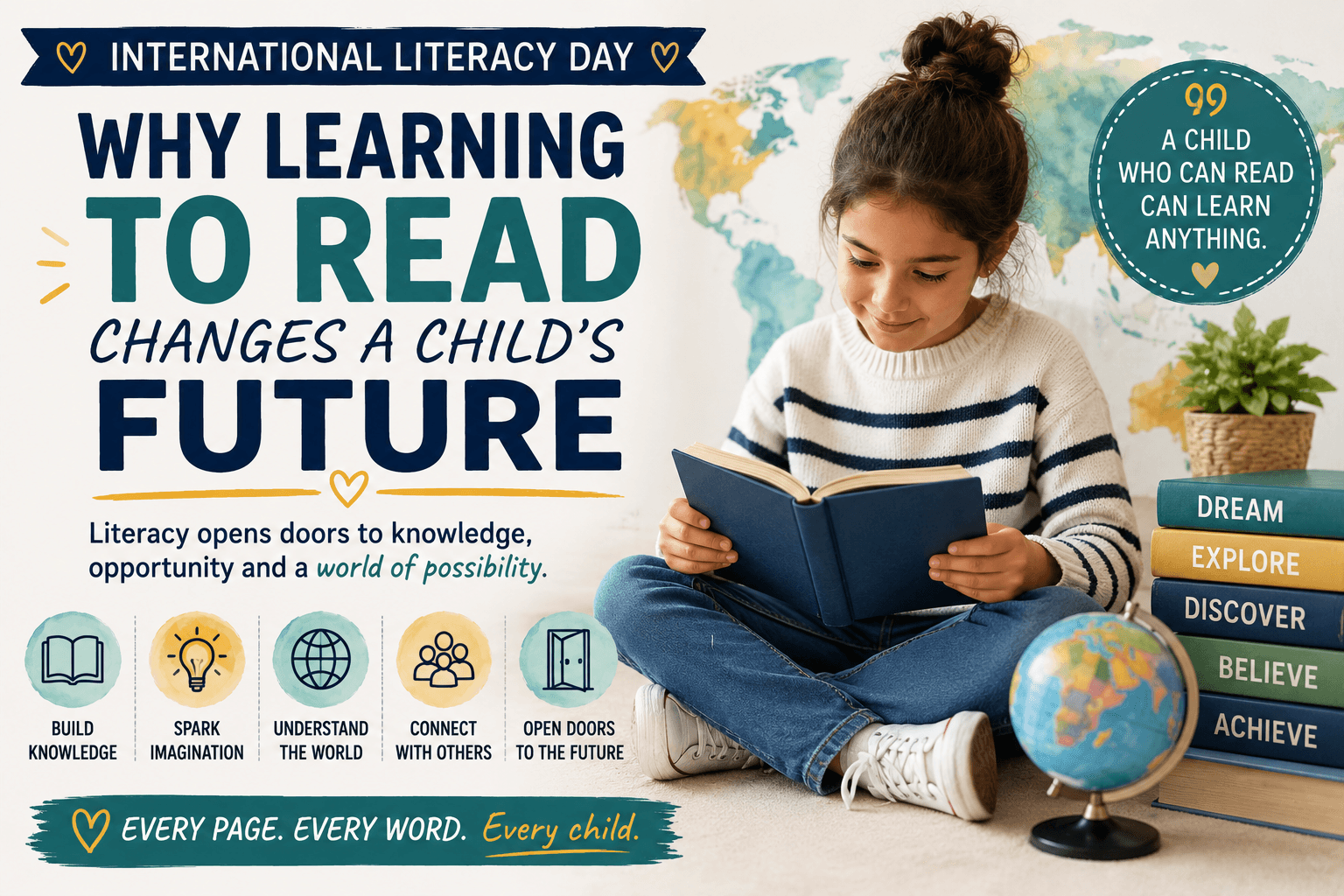
Learning to read does not guarantee a particular future. But it dramatically expands the futures a child can access. Literacy gives children greater independence. It helps them seek information for themselves. It allows them to explore ideas beyond their immediate environment. It gives them access to stories written hundreds of years ago and discoveries made yesterday. It allows them to communicate, investigate, question and learn. And most importantly, literacy gives children one of the most powerful tools for lifelong learning. A child who can read independently is no longer limited to what another person has time to explain. They can begin to discover for themselves.
International Literacy Day: A Reminder for All of Us
International Literacy Day is rightly concerned with enormous global questions:
How do we improve access to education?
How do we reduce literacy inequalities?
How do we support children and adults who have been left behind?
How do we ensure changing technology does not deepen existing inequalities?
But there is also a much smaller message families can take from the day. Reading matters. The ten minutes you spend practising phonics matters. The bedtime story matters. Going back to a sound your child has forgotten matters. Talking about an unfamiliar word matters. Visiting the library matters. Letting your child see you read matters. Helping them struggle through a word rather than immediately telling them matters. None of those moments looks particularly dramatic. Together, they build readers.
Literacy is about far more than passing a reading assessment. It is about access.
Access to education.
Access to information.
Access to stories.
Access to opportunities.
Access to ideas.
Access to independence.
The journey begins long before a child reads fluently. It begins with language, conversation and stories. Then come sounds. Letters. Blending. Words. Sentences. Fluency. Comprehension. Knowledge. Each stage builds upon another. And while children will travel through those stages at different speeds, the goal remains the same: not simply a child who can read, but a child who can use reading to learn, think, explore and participate in the world around them. This International Literacy Day, that is worth celebrating. Because teaching a child to read does more than help them understand the words on today's page. It gives them a tool they can use to continue learning for the rest of their life.