Bring the topic to life with our World Brain Day Workbook, packed with engaging brain facts, STEM challenges, puzzles, wellbeing activities and printable posters—[purchase your copy here].
Every parent wants to help their child succeed. We celebrate the first words, the first books read independently, the first times tables mastered, and the moments when something suddenly “clicks.” Yet learning can also be frustrating. Children sometimes forget things they appeared to know. They struggle with concepts that seem simple to adults. They need reminders, repetition, and reassurance. These experiences often leave parents wondering:
“Why is learning so difficult sometimes?”
“Why does my child forget things so quickly?”
“Am I doing enough to support them?”
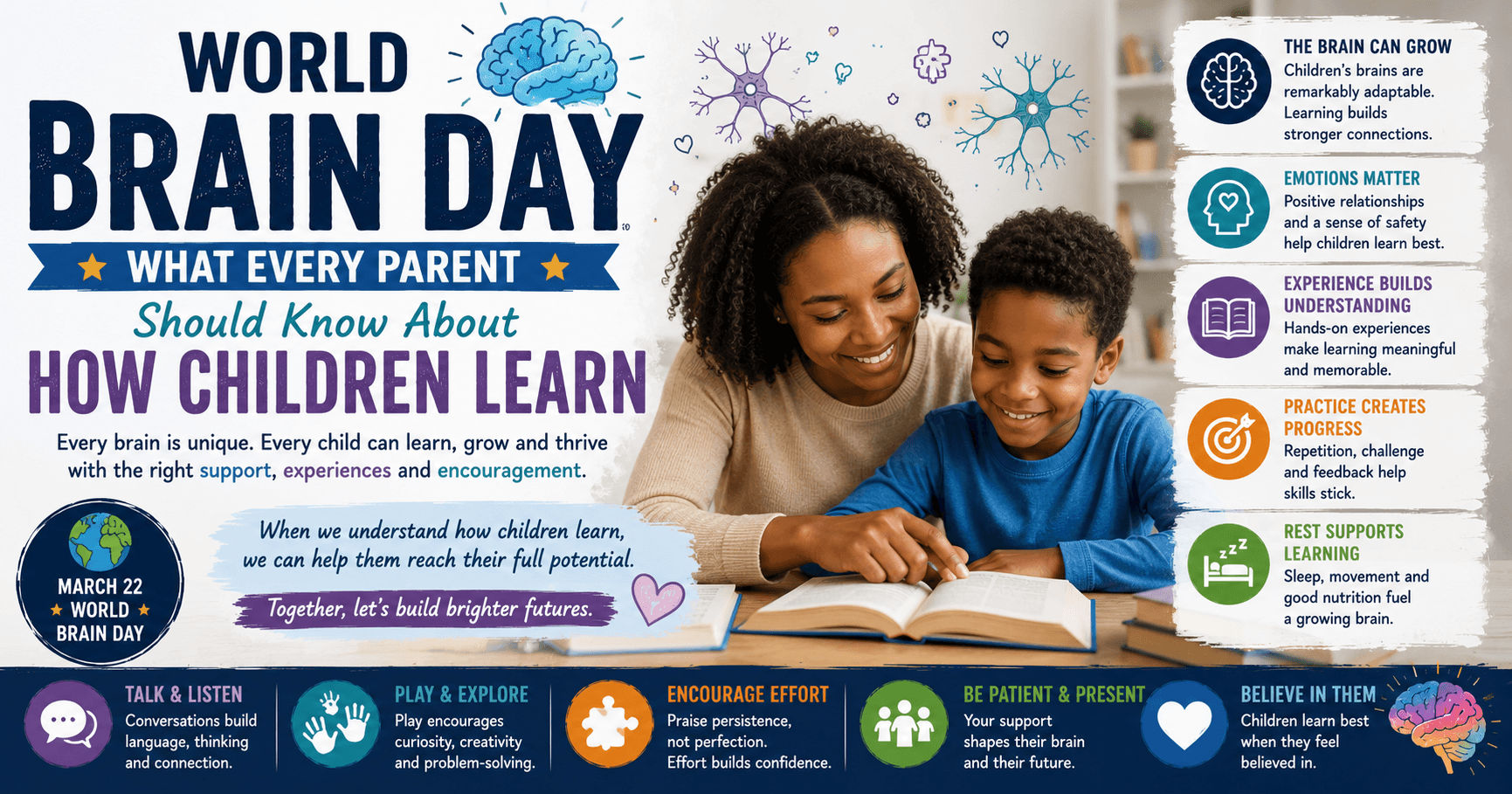
The good news is that many of the challenges children experience are a normal part of how the brain learns. World Brain Day provides an opportunity not only to celebrate the incredible organ that makes learning possible but also to better understand how children learn, remember, think, and develop. When parents understand how learning works, they can support their children more effectively and with less frustration.
The Brain Is Not a Storage Box
Many people imagine learning as putting information into a child’s brain, like placing books onto a shelf. In reality, learning is far more complex. The brain is constantly:
Building connections
Strengthening pathways
Filtering information
Making predictions
Solving problems
Adapting to new experiences
Learning changes the physical structure of the brain. Each time children practise a skill, recall information, solve a problem, or make a connection, neural pathways become stronger. This process is known as neuroplasticity. Simply put:
The brain changes based on experience.
Every meaningful learning experience helps shape and strengthen the brain.
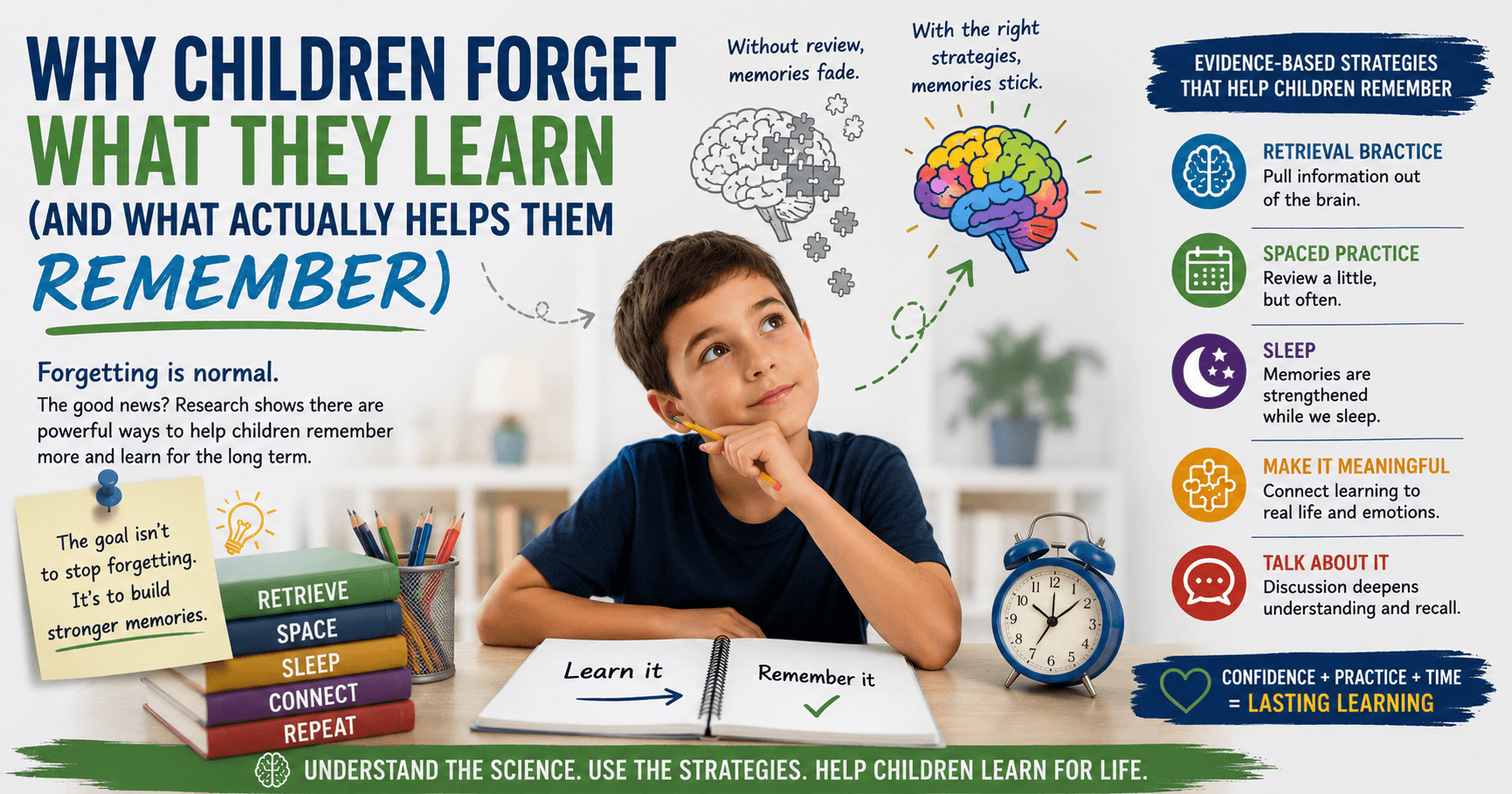
Why Children Forget What They Learn
One of the most surprising discoveries in cognitive science is that forgetting is normal. Parents often worry when a child forgets:
Spellings
Times tables
Vocabulary
Reading strategies
Scientific facts
However, forgetting is not necessarily a sign that learning has failed. The brain receives enormous amounts of information every day. If we remembered everything equally well, our brains would quickly become overwhelmed. Instead, the brain prioritises information that appears important and useful. Research into the Forgetting Curve, first identified by psychologist Hermann Ebbinghaus, shows that information fades quickly unless it is revisited and retrieved. This means children need opportunities to:
Practise
Revisit
Recall
Apply
Learning something once is rarely enough. Strong memories are built over time.
Learning Is Not the Same as Performance
One of the biggest misconceptions in education is that performing well during a lesson means learning has occurred. A child may:
Complete a worksheet successfully
Answer questions correctly
Follow along during teaching
Yet still struggle to remember the information later. Why? Because performance and learning are not the same thing. True learning becomes visible when a child can retrieve information independently after some time has passed. This is why children sometimes appear to “know” something one day and struggle the next. Learning is a process, not a single event.
Retrieval: The Brain’s Secret Learning Tool
Many parents believe that the best way to help children remember information is to keep showing it to them. Research suggests something different. One of the most effective ways to strengthen memory is retrieval. Retrieval means recalling information from memory without looking at notes or answers. Examples include:
Asking a child to explain yesterday’s lesson
Quizzing vocabulary words
Recalling key facts from a book
Explaining a maths method aloud
Every successful retrieval strengthens memory. Think of it as exercise for the brain. The more frequently information is recalled, the easier it becomes to access in the future.
Why Repetition Matters
Children often need far more repetition than adults expect. A skill that feels automatic to an adult may require dozens or even hundreds of successful repetitions before it becomes secure for a child. This is particularly true for:
Reading
Spelling
Number facts
Handwriting
Phonics
Mathematical procedures
Repetition is not evidence that a child is struggling. It is evidence that the brain is strengthening important pathways.
Sleep Is Part of Learning
Many parents focus on homework, revision, and educational activities. Few realise that one of the most powerful learning tools is sleep. During sleep, the brain consolidates memories. Information learned throughout the day is organised, strengthened, and integrated with existing knowledge. Research consistently links good sleep with:
Better memory
Improved concentration
Stronger problem-solving skills
Greater emotional regulation
A tired brain finds learning much harder. Protecting sleep routines may be one of the most valuable things parents can do for learning.
Emotion and Learning Are Connected
The brain does not separate emotions from learning. Children learn best when they feel:
Safe
Supported
Valued
Confident
Stress and anxiety can interfere with attention and memory. When children feel threatened, embarrassed, or overwhelmed, the brain focuses on managing those emotions rather than learning. This is why relationships matter. Children are more likely to engage, take risks, and persist when they feel emotionally secure. Learning is not simply about information. It is also about how children feel while learning.
Curiosity Is the Brain’s Learning Engine
Think about something your child loves: dinosaurs, space, football, animals, minecraft.
Many children can remember astonishing amounts of information about topics that interest them. Why? Because curiosity increases attention Attention is the gateway to learning. When children are genuinely interested, their brains become more receptive to new information. Curiosity encourages:
Exploration
Questioning
Investigation
Persistence
One of the most powerful ways to support learning is to nurture curiosity.
Mistakes Help the Brain Grow
Many children fear getting things wrong. Parents often worry when children make repeated mistakes, however, mistakes play an important role in learning. The brain learns through feedback. Every mistake provides information. It helps the brain adjust understanding and refine future responses. Children who view mistakes as part of learning are often more resilient and willing to tackle challenges. This idea is closely connected to growth mindset research, which suggests that abilities can develop through effort, practice, and persistence. Learning is rarely a straight line. Progress often includes setbacks, confusion, and mistakes along the way.
Why Play Matters More Than Many People Realise
Play is not separate from learning. For young children especially, play is one of the brain’s most important learning tools. Through play, children develop:
Language
Problem-solving
Creativity
Social skills
Self-regulation
Imagination
Play allows children to experiment, explore, test ideas, and make sense of the world. Even older children continue to benefit from games, puzzles, investigations, and hands-on experiences. Meaningful learning often happens when children are engaged and enjoying themselves.
How Parents Can Support Brain-Friendly Learning
Parents do not need specialist qualifications to support learning effectively. Simple strategies can make a significant difference.
Read Together Daily
Reading develops language, knowledge, vocabulary, and comprehension.
Encourage Retrieval
Ask children to tell you what they remember rather than immediately providing answers.
Celebrate Effort
Praise persistence, resilience, and problem-solving.
Protect Sleep
Consistent sleep routines support memory and concentration.
Reduce Overload
Break tasks into manageable steps.
Encourage Questions
Curiosity drives learning.
Make Learning Meaningful
Connect new knowledge to real-life experiences whenever possible.
What World Brain Day Reminds Us
World Brain Day is a celebration of one of the most remarkable organs in the human body. For parents, it is also a reminder that learning is not simply about grades, tests, or memorising facts.
Learning is about building connections.
Developing confidence.
Strengthening understanding.
Growing through challenge.
And creating experiences that help children make sense of the world around them. When we understand how the brain learns, we become more patient with the process.
We recognise that forgetting is normal.
Mistakes are valuable.
Practice matters.
Sleep matters.
Curiosity matters.
Most importantly, we begin to see learning not as a race but as a journey.
Every child’s brain is unique. Children learn at different rates, in different ways, and through different experiences. The goal is not to create perfect learners. The goal is to support children as they develop confidence, curiosity, resilience, and a lifelong love of learning. This World Brain Day, take a moment to appreciate the incredible work happening inside your child’s brain every day. Even when progress feels slow. Even when learning looks messy. Even when mistakes happen. Because every question asked, every challenge attempted, and every new experience contributes to the remarkable process of learning.
Ready to continue exploring how the brain learns, remembers and grows? Our World Brain Day Workbook gives children a fun, meaningful way to put these ideas into practice—[purchase it here].