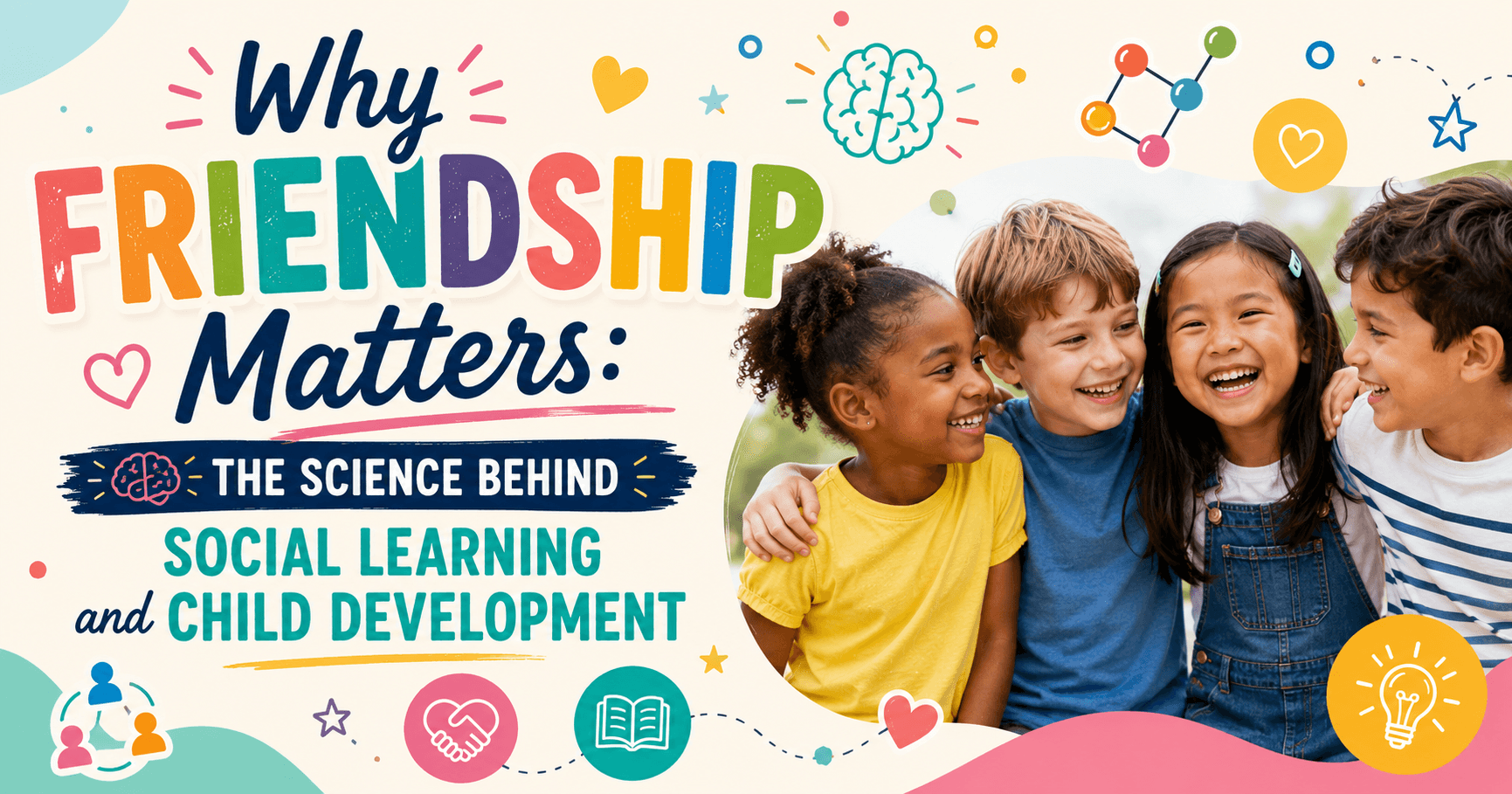
When parents think about their child’s education, they often focus on reading, writing, mathematics, and academic achievement. While these skills are undoubtedly important, there is another aspect of development that plays a powerful role in children’s learning, wellbeing, and future success: friendship. From sharing toys in the early years to navigating complex social groups in adolescence, friendships help children develop essential skills that influence far more than their social lives. Research increasingly shows that positive friendships contribute to emotional wellbeing, cognitive development, academic success, resilience, communication skills, and even long-term health outcomes. Friendships are not simply a pleasant addition to childhood. They are an important part of how children learn, grow, and make sense of the world around them. Understanding the science behind friendship can help parents, educators, and home educators support children’s social development in meaningful ways.
Why Human Beings Are Social Learners
Humans are naturally social creatures. From birth, children learn through relationships. Babies learn language through interaction. Toddlers learn social rules through play. Children develop communication skills through conversations and shared experiences. Psychologists have long recognised that learning is not solely an individual process. Russian psychologist Lev Vygotsky argued that much of children’s learning occurs through social interaction. His work emphasised that children develop knowledge and understanding through conversations, collaboration, and shared experiences with others.
Simply put:
Children learn from people.
Friendships provide some of the richest opportunities for this type of learning.
What Is Social Learning?
Social learning refers to learning that occurs through observing, interacting with, and engaging with others. Children learn by:
Watching behaviour
Listening to conversations
Collaborating on tasks
Solving problems together
Receiving feedback
Friendships provide daily opportunities for all of these experiences. A child may learn:
How to negotiate
How to compromise
How to solve disagreements
How to understand different perspectives
How to communicate effectively
These skills are not always explicitly taught. They are often developed through social experiences.
Friendship Supports Emotional Development
One of the most important benefits of friendship is emotional growth. Friendships help children understand emotions in themselves and others. Through friendships, children learn:
Empathy
Kindness
Compassion
Perspective-taking
Emotional regulation
When a friend feels upset, children begin learning how emotions affect others. When conflicts occur, they learn how to manage disappointment, frustration, and misunderstandings. Research suggests that children with strong friendships often demonstrate higher levels of emotional competence and social understanding.
Friendship Helps Children Develop Empathy
Empathy is the ability to understand and respond to the feelings of others. It is a crucial skill for healthy relationships and successful social interactions. Friendships provide natural opportunities to practise empathy.
Children begin to recognise:
How others feel
Why people react differently
How their actions affect others
These experiences help build emotional intelligence, which is increasingly recognised as an important predictor of future success and wellbeing.
The Role of Friendship in Communication Skills
Communication is about much more than speaking. Children must learn how to:
Listen
Explain ideas
Ask questions
Clarify misunderstandings
Interpret social cues
Friendships provide daily opportunities to practise these skills. A child organising a game, negotiating rules, or resolving a disagreement is developing communication abilities that will benefit them throughout life. Strong communication skills support both academic achievement and future workplace success.
Friendship and Academic Achievement
Many parents are surprised to learn that friendships can influence academic outcomes. Research has found that positive peer relationships are associated with:
Greater school engagement
Improved motivation
Better attendance
Higher academic achievement
Why?
Children often feel more confident and secure when they have positive social connections. A sense of belonging can increase participation, persistence, and willingness to take academic risks. When children feel socially connected, they are often better able to focus on learning.
Learning Through Collaboration
Modern education increasingly emphasises collaboration. Children are frequently asked to:
Work in pairs
Complete group projects
Discuss ideas
Solve problems together
Friendships help prepare children for these experiences. Collaborative learning encourages:
Communication
Perspective-taking
Critical thinking
Problem-solving
Children often learn new ideas and strategies from their peers. In many cases, explaining a concept to a friend can strengthen understanding for both children involved.
Friendship Builds Resilience
Childhood is filled with challenges. Children experience:
Mistakes
Disappointments
Failure
Change
Uncertainty
Supportive friendships can act as a protective factor during difficult times. Research suggests that children with positive friendships often demonstrate greater resilience when facing challenges.
Friends provide:
Encouragement
Understanding
Emotional support
A sense of belonging
Knowing that someone cares can make challenges feel more manageable.
Friendship and Mental Wellbeing
Growing evidence suggests that strong social relationships contribute to positive mental health. Children who experience healthy friendships often report:
Greater happiness
Higher self-esteem
Lower levels of loneliness
Stronger feelings of belonging
Positive relationships help children feel valued and accepted. This contributes to overall wellbeing and confidence. While all children experience occasional disagreements or friendship difficulties, having meaningful social connections remains an important part of healthy development.
The Science of Belonging
Human beings have a fundamental need to belong. Psychologists Roy Baumeister and Mark Leary proposed that forming and maintaining social relationships is a basic human motivation. Children are no exception. Feeling connected to others influences:
Motivation
Confidence
Emotional wellbeing
Engagement
A child who feels accepted is often more willing to participate, explore, and take on new challenges. Belonging supports learning because children feel emotionally safe.
Friendship Teaches Conflict Resolution
Friendships are not always easy.
Disagreements happen.
Arguments occur.
Feelings get hurt.
While these situations can be difficult, they also provide valuable learning opportunities.
Children develop:
Negotiation skills
Problem-solving abilities
Perspective-taking
Emotional regulation
Learning how to repair relationships is an important life skill. Children who navigate friendship challenges gain experience managing conflict constructively.
Quality Matters More Than Quantity
Parents sometimes worry about the number of friends their child has. However, research suggests that friendship quality is often more important than friendship quantity. A child does not need a large social circle to thrive. One or two supportive, positive friendships can provide significant benefits. Strong friendships are often characterised by:
Trust
Respect
Kindness
Mutual support
Shared interests
Meaningful connections matter more than popularity.
Supporting Children Who Find Friendships Difficult
Not all children find friendships easy. Some children are naturally more reserved. Others may struggle with social communication, confidence, anxiety, or past experiences. Parents can help by:
Creating Opportunities
Encourage participation in clubs, activities, and community groups.
Modelling Social Skills
Children learn by observing adult relationships.
Talking About Friendship
Discuss kindness, empathy, communication, and problem-solving.
Supporting Interests
Shared interests often provide natural pathways to friendship.
Being Patient
Friendships develop at different rates.
Every child follows their own social journey.
Friendship in the Digital Age
Today’s children are growing up in a world where friendships increasingly extend into digital spaces. While technology can help children stay connected, research continues to highlight the importance of face-to-face interaction. In-person friendships provide opportunities for children to:
Read body language
Interpret facial expressions
Develop conversational skills
Build deeper social understanding
Digital communication can complement friendships, but it should not entirely replace real-world social experiences.
What Friendship Teaches Children About Life
Friendship helps children develop some of the most important skills they will ever learn. Through friendship, children discover:
How to care for others
How to communicate effectively
How to cooperate
How to solve problems
How to manage emotions
How to build trust
These skills influence relationships, education, careers, and wellbeing throughout adulthood.
Friendships may not appear on school reports, yet they play a powerful role in children’s development. The science is clear: positive friendships support emotional wellbeing, social learning, resilience, communication skills, academic success, and overall development.
Children do not learn in isolation.
They learn through relationships.
They learn through conversations.
They learn through shared experiences.
They learn through friendship.
As parents and educators, supporting children’s social development is not separate from supporting their learning. It is an essential part of it. Because when children build strong friendships, they are not simply making memories. They are developing the skills, confidence, and emotional foundations that help them thrive throughout life.