When we talk about respectful children, we often think about behaviour. Saying please and thank you. Waiting for someone to finish speaking. Following instructions. Using polite words. These things are important. But respect is much bigger than good manners.
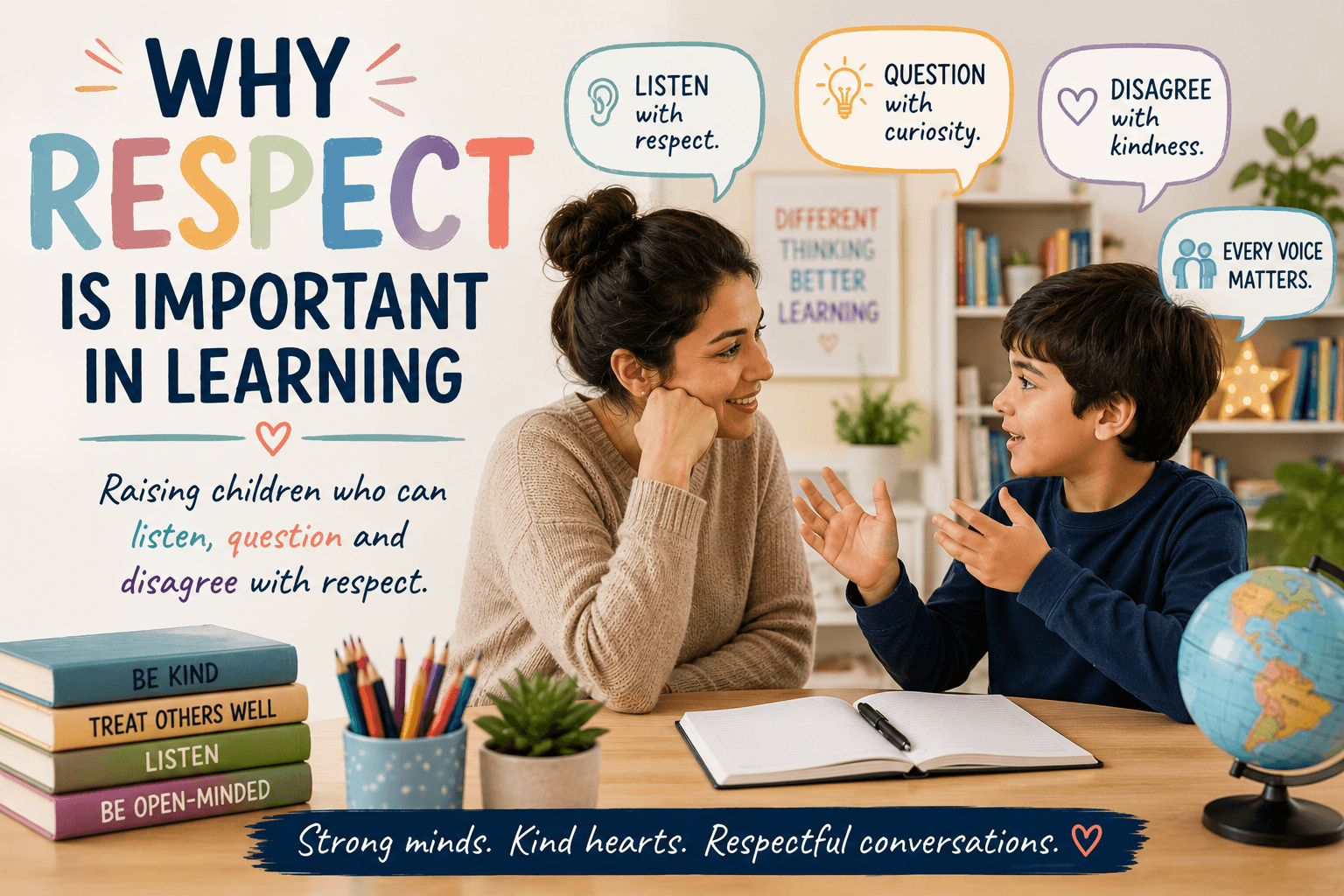
In education, respect shapes how children communicate, how they respond when somebody disagrees with them, how willing they are to listen to another perspective and whether they feel confident enough to question something they do not understand. And that last part is important. A respectful child is not necessarily a child who quietly agrees with every adult. We should not be trying to raise children who simply comply. We want children who can listen carefully, think critically, ask questions, challenge ideas and express disagreement without losing respect for the person on the other side of the conversation.
That distinction matters in classrooms. It matters in home education. It matters online. And it will matter enormously as children grow into adults navigating relationships, workplaces and a world increasingly filled with competing opinions. So perhaps one of the most valuable things we can teach children is this: You can disagree with someone and still treat them with dignity.
Respect and Obedience Are Not the Same Thing
This is an important place to begin. Respect is sometimes confused with obedience. But they are not interchangeable. Obedience means following an instruction or complying with a request. Respect involves recognising the value, rights, boundaries and perspectives of another person. Sometimes respectful behaviour will involve following an adult's instruction. A child needs to stop when an adult says: "Don't cross the road." There are situations where adults have responsibility for children's safety and must establish clear boundaries.
But education also requires something different. Children need opportunities to ask:
Why?
How do we know?
What if...?
Could there be another explanation?
I don't understand.
I disagree.
A child asking those questions is not necessarily being disrespectful. They may be thinking. And thoughtful questioning is something education should develop, not suppress.
Children Learn Respect Through Relationships
Children do not learn respect simply because adults tell them to "be respectful". They learn what respectful relationships look like by experiencing them. That means adult behaviour matters enormously.
When a child asks a question, do we listen?
When they make a mistake, do we embarrass them?
When they disagree, do we immediately interpret it as defiance?
When they tell us something feels unfair, do we allow them to explain?
When we make a mistake ourselves, can we admit it?
Children are constantly observing how adults use power. If we expect children to listen while routinely interrupting them, they notice. If we demand apologies but never apologise ourselves, they notice. If we insist they consider other people's perspectives while dismissing theirs, they notice that too. Respect is taught most powerfully when it is modelled.
Respect Creates Emotional Safety for Learning
Learning requires vulnerability. To learn something new, children have to repeatedly experience not knowing. They attempt an unfamiliar word. They answer a maths question. They pronounce something incorrectly. They share an idea. They write a sentence. They ask a question. And sometimes they get it wrong. A learning environment therefore needs to make mistakes psychologically manageable. Imagine a child who believes every incorrect answer will be laughed at, criticised or treated as evidence that they are not clever. What happens?
They may stop volunteering answers. They may avoid difficult tasks. They may pretend to understand. They may copy someone else. They may become anxious about making mistakes.
A respectful learning environment communicates something different: "Your answer might be wrong, but you are safe to think here." That does not mean pretending every answer is correct. Good teaching requires feedback and correction. But we can correct an idea without diminishing the child who offered it.
Listening Is a Skill
We often tell children: "Listen." But listening is not simply remaining silent while another person speaks. Genuine listening requires attention. Children gradually learn to:
follow another person's explanation,
hold information in mind,
identify the important point,
interpret meaning,
ask relevant questions,
and respond to what was actually said.
These skills support learning across the curriculum. A child listening to another person's explanation of a maths strategy may discover a different method. A child listening during a history discussion may encounter another interpretation. A child listening to a sibling explain why they are upset begins practising perspective-taking. Listening therefore sits at the intersection of communication, learning and social development.
But Children Also Need to Know Their Voice Matters
Respect should never become a one-way system where children listen and adults speak. Children need opportunities to contribute. That might mean explaining how they solved a problem. Asking why something happened. Offering an alternative interpretation of a story. Saying that they do not understand an explanation. Or respectfully challenging something an adult has said. This matters because learning is not simply the transfer of information from adult to child. Children need to process ideas. And one of the ways we process ideas is by talking about them.
Questions Are a Sign of Thinking
Anyone who spends time with young children knows how naturally curious they can be.
Why is the sky blue?
Where does rain come from?
Why do people speak different languages?
Who decided how words are spelled?
Why can't we see gravity?
What was here before this building?
Questions are one of the engines of learning. Yet as children grow older, some become increasingly reluctant to ask them. Sometimes they worry that the question is silly. Sometimes they do not want other people to know they are confused. Sometimes previous experiences have taught them that adults prefer quick compliance to prolonged curiosity. A respectful learning environment makes room for questions. Not every question can derail an entire lesson. But children should know that curiosity is welcome. Sometimes the best learning begins with: "I don't know. Let's find out."
Respect and Critical Thinking Belong Together
We are raising children in an age of extraordinary access to information. A child can search for an answer within seconds. Artificial intelligence can produce a confident explanation almost instantly. Social media exposes children to opinions from around the world. That makes critical thinking increasingly important. Children need to ask:
Who is making this claim?
What evidence supports it?
Could this information be wrong?
Is this fact or opinion?
Is another perspective missing?
Why should I believe this?
We cannot simultaneously tell children to question information and teach them that questioning authority is inherently disrespectful. Instead, children need to learn the distinction between challenging an idea and attacking a person.
Teach Children How to Disagree
Disagreement is inevitable. Children will disagree with siblings, friends, parents, teachers, eventually colleagues, partners and people they encounter in wider society. The aim cannot be to eliminate disagreement. It should be to teach children how to navigate it.
Compare: "That's stupid." with: "I don't agree because..."
Or: "You're wrong." with: "Could there be another explanation?"
Or: "That makes no sense." with: "I don't understand how you reached that answer."
The disagreement has not disappeared. But the communication has changed. Children can learn phrases such as:
"I see it differently because..."
"Can you explain why you think that?"
"I understand your point, but..."
"What evidence supports that idea?"
"I hadn't thought about it that way."
"I still disagree, but I understand what you mean."
These are not simply classroom phrases. They are life skills.
Changing Your Mind Is Not Losing
There is another important lesson children can learn through respectful discussion: It is okay to change your mind. Sometimes children and adults begin treating disagreement as a competition. Someone must win. Someone must lose. But thoughtful discussion should allow something else to happen. We hear new information. We reconsider. We realise part of our argument was wrong. We adjust our opinion. That is not weakness. It is intellectual growth. We can model this explicitly: "I hadn't considered that. You've changed my mind." Or: "You're right, I made a mistake." For a child, hearing an adult say those words can demonstrate that knowledge is not about protecting our ego. It is about moving closer to understanding.
Respect Helps Children Learn From People Who Are Different From Them
Children will encounter people whose experiences differ from their own, different cultures, languages, families, abilities, beliefs, traditions, opinions and ways of communicating. A respectful education does not require children to agree with every idea they encounter.
It teaches them to approach difference with curiosity rather than immediate contempt. Instead of: "That's weird." we can encourage: "Why do they do that?"
Instead of assuming unfamiliar means wrong, children can investigate context. For home-educating and worldschooling families, there can be particularly rich opportunities for this kind of learning. Museums, travel, books, documentaries, community groups, historical sites and conversations with people from different backgrounds can all expose children to ways of living and thinking beyond their immediate experience.
Worldschooling Can Make Respect Tangible
When children travel, respect stops being an abstract classroom value. They encounter places where: people greet one another differently, food customs differ, religious or cultural practices may be unfamiliar, different languages are spoken, social expectations change, and history may be understood from another national perspective. Children can learn that entering another culture does not mean expecting that culture to behave exactly like their own. Before visiting somewhere, families might explore:
How do people greet one another?
Are there expectations around clothing?
What behaviour is appropriate at religious or historical sites?
What words could we learn in the local language?
What history should we understand before we arrive?
That is education. It combines geography, history, language, culture and social understanding.
Respect Matters in Home Education Too
Home education often changes the traditional relationship between adult and learner. Parents may move between several roles during the day. Anyone who has attempted to teach their own child something knows that the relationship is not always straightforward. A child may happily accept an explanation from somebody else and immediately reject exactly the same explanation from a parent. Respect therefore needs to work in both directions. Parents can maintain expectations without requiring every learning experience to become a power struggle.
Sometimes the question is not: "How do I make my child do this?" but: "What is making this difficult?"
Are they tired?
Is the work too easy?
Too difficult?
Are the instructions unclear?
Do they need movement?
Have they misunderstood?
Are they frustrated because they cannot yet do something they expected to find easy?
Listening does not mean removing every expectation. It means gathering information before deciding how to respond.
Boundaries Are Compatible With Respect
Respectful parenting and education do not mean children make every decision. Children need boundaries. Adults have greater experience and responsibility. There will be times when the answer is simply no. But even firm boundaries can be communicated respectfully. "I know you're disappointed. The answer is still no."
Acknowledging a child's feelings does not require changing the decision. Similarly, allowing children to question a rule does not mean every rule becomes negotiable. A child can understand: "You're allowed to disagree with the boundary. You're not allowed to hurt somebody because you're angry about it."
That distinction helps children learn both agency and responsibility.
Respectful Learning Does Not Mean Avoiding Correction
There is sometimes a misconception that protecting children's confidence means avoiding telling them when something is wrong. But children need accurate feedback. If a child reads ship as sip, we should not pretend it was correct. If 7 × 6 is answered as 36, the child needs to know. If a historical claim is inaccurate, it should be corrected. Respect changes how we respond.
Instead of: "No. That's wrong." we might say: "Have another look at the beginning of the word. What sound does sh make?" Or: "Let's check that calculation. Can you show me how you worked it out?" The purpose of feedback is to move learning forward. It should provide information, not humiliation.
Children Need to Learn How to Receive Disagreement Too
Teaching respectful disagreement has another side. Children will sometimes be challenged themselves. Someone will say: "I don't agree with you." That can feel uncomfortable. Children need experience discovering that disagreement is not necessarily rejection. A friend can disagree and remain a friend. A teacher can correct an answer without thinking the child is unintelligent. A parent can challenge an opinion while still valuing the child's voice. Separating ideas from identity is an important part of intellectual development. "That argument isn't supported by the evidence" is different from: "You aren't clever." Children who understand that distinction may become more willing to take intellectual risks.
What About Respect Online?
Modern children also need to learn how respect works digitally. Online communication removes many of the cues present in face-to-face conversation. We cannot always hear tone. We cannot always see facial expressions. People may say things online that they would never say to somebody sitting beside them. Children therefore need explicit conversations about digital communication. Before posting or sending something, they can ask:
Would I say this to the person's face?
Am I criticising the idea or insulting the person?
Do I actually know this information is true?
Am I sharing something that belongs to somebody else?
Does this need to be said publicly?
Digital literacy is not simply learning how technology works. It includes learning how to behave responsibly while using it.
Adults Don't Automatically Deserve Agreement
This may be one of the most important distinctions we can teach. Children should learn to treat people respectfully. But that does not mean believing everything an adult says. Safeguarding depends partly on children understanding that adults can be wrong. Children need permission to say:
"No."
"I don't understand."
"That doesn't feel right."
"I need to tell somebody."
Teaching respect should never mean teaching unquestioning compliance. We want children who understand appropriate boundaries while retaining their ability to think, question and seek help.
A Simple Family Discussion Activity
Try introducing a question where there is no single obvious answer. For example:
Should children have homework?
Should zoos exist?
Should children be allowed smartphones?
Should school uniforms be compulsory?
Would you rather explore the ocean or space?
Ask each person to explain their position. Then introduce one rule:
Before disagreeing, you must accurately explain what the other person believes.
This changes the conversation. Children cannot simply wait for their turn to speak. They have to listen. You might then ask:
"What was the strongest point made by someone who disagreed with you?"
Now disagreement becomes an exercise in understanding rather than winning.
The Goal Isn't a Child Who Never Challenges You
A child who never disagrees is not necessarily a child who has learned respect. They may simply have learned that disagreement is unwelcome. The longer-term goal is much more ambitious. We want children who can say:
"I don't think that's right, and here's why."
Children who listen before responding. Children who ask questions when something does not make sense. Children who can hear another perspective without immediately becoming defensive. Children who can change their minds when evidence changes. Children who understand that confidence does not require cruelty. And children who know that treating another person with dignity does not require surrendering their own judgement.
Respect has an important place in education. But we should be careful about what we mean by it. Respect is not silence. It is not unquestioning obedience. It is not pretending to agree. And it is not adults demanding behaviour from children that they are unwilling to model themselves. Respectful learning means creating environments where children learn to listen carefully, speak thoughtfully, question confidently and disagree constructively.
It means showing children that ideas can be challenged without people being attacked. That mistakes can be corrected without humiliation. That authority can be questioned without hostility. That another perspective can be understood without necessarily being adopted. And that changing your mind when you encounter better evidence is a strength.
Education should give children knowledge. But it should also teach them what to do when their knowledge meets somebody else's. Because throughout their lives, our children will encounter people who think differently from them. We cannot prepare them by ensuring they never experience disagreement. We prepare them by teaching them how to handle it.