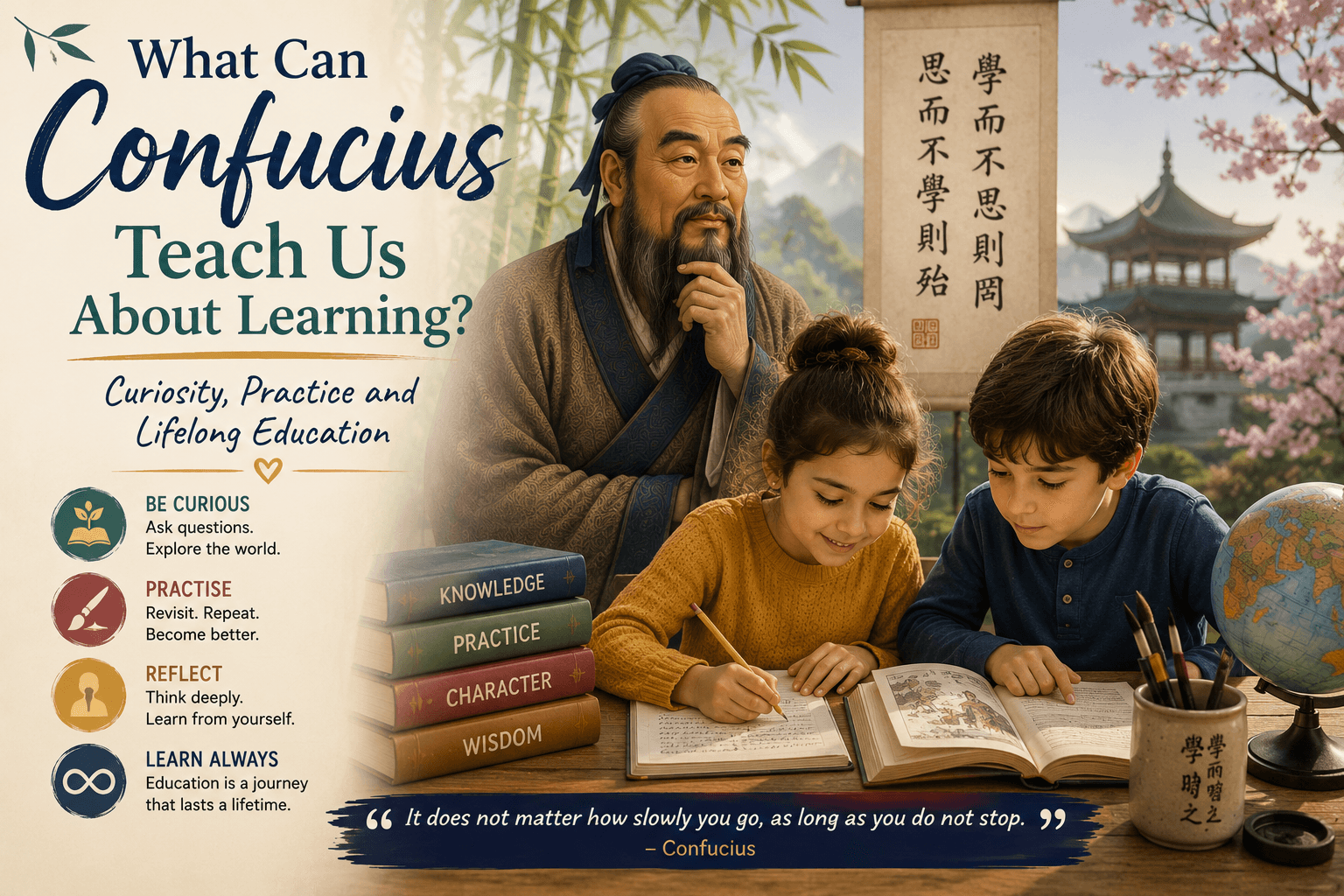
More than 2,500 years ago, a Chinese teacher and philosopher began exploring questions that still sit at the heart of education today.
What makes a good learner?
What makes a good teacher?
Is education simply about acquiring knowledge, or should it also shape character?
Why is practice necessary?
What happens when we question what we think we know?
And perhaps most importantly: Does learning ever really finish?
Confucius lived in ancient China between 551 and 479 BCE, yet many of the ideas associated with his educational philosophy feel surprisingly familiar. He placed enormous value on education, reflection, self-improvement, moral development and the responsibility of both teachers and learners. Of programme, we should be careful about lifting ideas from ancient China and placing them directly into modern education. Confucius lived in a very different society, and his philosophy developed within its own historical and cultural context.
But educational history gives us an opportunity to do something valuable. Not simply ask: "What did people in the past believe?" But: "Does any of it still help us think about education today?"
For Confucius, the answer may well be yes. Because beneath the historical distance are several ideas modern families may recognise immediately:
Learning requires practice.
Knowledge should be accompanied by reflection.
Teachers matter.
Character matters alongside academic achievement.
And education should continue throughout life.
Who Was Confucius?
Confucius, known in Chinese as Kongzi or Kong Fuzi, was a teacher, thinker and political philosopher who lived during the late Zhou period of Chinese history. He lived at a time of considerable political and social instability. His ideas concerned far more than education. He thought deeply about government, family relationships, morality, social responsibility and how people should conduct themselves. Education, however, was central to his thinking. Confucius taught students and developed ideas about how individuals could improve themselves through learning, reflection and disciplined practice. He did not leave behind a book written entirely by himself. Many of the teachings traditionally associated with him were recorded and compiled by followers and later generations, most famously in the Analects. His influence would eventually become enormous, shaping educational and philosophical traditions across China and other parts of East Asia for centuries.

Education Was About More Than Knowing Facts
When we think about education today, we often think about measurable outcomes, reading levels, qualifications, exam results, grades, academic progress. Confucian education certainly valued knowledge, but learning was connected to a much broader process of self-cultivation. Education was partly about becoming a better person. Learning should influence how someone behaved. How they treated other people. How responsibly they fulfilled their role within society. How carefully they thought. How willing they were to examine their own behaviour. This creates an interesting question for modern education.
What is education ultimately for?
Is it simply preparation for employment?
Is it about passing examinations?
Is it acquiring knowledge?
Developing independence?
Building character?
Learning how to participate in society?
Most of us would probably answer that it is some combination of these things. Confucius reminds us that debates about the purpose of education are certainly not new.
1. Learning Requires Practice
One of the strongest themes associated with Confucian thinking is the importance of learning followed by practice. This feels relevant to what we now understand about learning. Children rarely encounter something once and permanently master it. A child may learn a phoneme today and struggle to retrieve it next week. They may understand multiplication during a lesson but need repeated practice before recall becomes automatic. They may spell a word correctly in one activity and incorrectly several days later. That does not necessarily mean the original learning failed. It means learning needs to become secure.
Modern cognitive science describes the importance of processes such as retrieval practice, spaced practice and repeated application. Confucius obviously did not have modern neuroscience or cognitive psychology available to him. But the basic observation remains recognisable: Encountering knowledge is not the same as mastering it. Learning requires return.
2. Repetition Does Not Have to Mean Mindless Drilling
The word repetition can sometimes have negative associations in education. We imagine children endlessly copying something they already understand. But useful practice is not simply doing the same worksheet twenty times. Children can revisit knowledge in different ways. For phonics, that might involve: reading a sound, finding it in words, blending words containing it, segmenting those words, spelling them, reading sentences, and eventually writing sentences containing the same spelling pattern. The underlying knowledge is being revisited, but the child is using it in increasingly complex contexts.
The same principle works elsewhere. A child learning fractions might: use physical objects, draw representations, compare fractions, solve calculations, and eventually apply fractions to real situations. Practice helps knowledge become more accessible.
3. Learning and Thinking Belong Together
Another important theme in Confucian philosophy is the relationship between learning and reflection. Accumulating information is not enough. Learners also need to think about what they know. That distinction remains extremely important. A child might memorise: The Battle of Hastings happened in 1066. Useful knowledge. But education can go further.
Why did the battle happen?
Who was involved?
What changed afterwards?
How reliable are our sources?
Would people living at the time have understood the event in the same way we do?
Knowledge provides something to think with. Critical thinking cannot exist in an intellectual vacuum. Children need knowledge, but they also need opportunities to examine, connect and apply it.
4. Curiosity Makes Knowledge Go Further
Confucius is often associated with active engagement in learning rather than passive receipt of information. This connects naturally with curiosity. A child who asks: "Why?" has opened a door.
Why does the Moon change shape?
Why do some words have silent letters?
Why did people build castles?
Why do countries have different currencies?
Why do languages change?
Why does ice float?
Adults do not always need to immediately provide the answer. Sometimes we can respond: "What do you think?" Or: "How could we find out?" Curiosity turns information into investigation.
5. But Curiosity and Knowledge Are Not Opposites
Modern educational discussions sometimes create a false choice. Either children memorise knowledge or they explore their interests. Either teaching is structured or learning is curious and child-led. In reality, children benefit from both. Knowledge often creates more curiosity. A child who knows nothing about Ancient Egypt has relatively few questions to ask about it. Once they learn about pyramids, hieroglyphics, pharaohs, mummification and the Nile, suddenly there are dozens.
How did they build the pyramids?
Why did they preserve bodies?
Could everyone read hieroglyphics?
What did children do?
Why was the Nile so important?
Knowledge gives curiosity somewhere to go.
6. Good Learners Are Active Learners
Children should not simply wait for knowledge to happen to them. As they grow, they can gradually take more responsibility for learning. They can learn to:
ask questions,
practise something they find difficult,
notice gaps in their understanding,
seek information,
check their work,
revisit previous learning,
and ask for help.
These are forms of metacognition—thinking about and regulating our own learning. A young child might need an adult to say: "Let's practise that sound again." An older learner can eventually recognise: "I keep forgetting this, so I need to revisit it." Ultimately, education should help children become increasingly capable of learning without somebody constantly directing every step.
7. Mistakes Give Us Information
Learning inevitably involves mistakes. Yet children can easily begin interpreting mistakes as evidence of ability.
"I got it wrong, so I'm bad at maths."
"I can't read that, so I'm not a good reader."
"My spelling is terrible."
A healthier learning culture treats mistakes as information. If a child repeatedly reads ship as sip, we have learned something. The sh digraph may need revisiting. If they correctly calculate addition problems but struggle when regrouping is required, we have identified a specific gap. The mistake helps guide teaching. This doesn't mean mistakes are the goal. The goal is eventually accurate, secure understanding. But mistakes can tell us what to teach next.
8. Reflection Makes Practice More Powerful
Imagine two children complete exactly the same activity. The first finishes and immediately moves on. The second spends a minute thinking:
What did I find easy?
What was difficult?
What mistake did I make?
What helped me solve it?
What should I practise again?
The second child has gained something additional from the experience. Reflection encourages learners to become aware of their own thinking. Parents can encourage this with very simple questions. After an activity, try asking:
"What did you learn?"
"What was tricky?"
"What helped?"
"What would you do differently next time?"
These questions can gradually help children understand themselves as learners.
9. Teachers Should Keep Learning Too
One of the most valuable ideas we can take from the Confucian tradition is that education is not something only children do. Teachers are learners. Parents are learners. Experts are learners. Adults should continue developing their understanding. This matters enormously in education because knowledge changes. Research develops. Teaching methods evolve. Technology changes the environments in which children learn. Our understanding of reading, memory, child development and cognition continues to grow. A qualification should never represent the final point at which an educator learns. It should be a foundation from which further learning continues.
10. Education and Character Are Connected
Confucian philosophy places considerable emphasis on moral development. Education was not simply intellectual. It was connected to becoming someone capable of behaving responsibly towards others. Modern families may use different language, but the underlying question remains relevant. Alongside academic knowledge, what qualities do we hope children develop?
Perhaps: kindness, honesty, perseverance, curiosity, responsibility, courage, respect, self-control, and compassion.
These qualities cannot always be measured neatly on a test. But they influence how children use everything else they learn.
11. Knowledge Without Character Has Limits
Imagine an academically brilliant person who cannot listen to another perspective. Someone highly educated who behaves dishonestly. Someone capable of solving complex problems but unwilling to consider how their actions affect others. Academic success alone does not guarantee wisdom. Education therefore has a wider responsibility. Children need opportunities to think about: fairness, responsibility, consequences, relationships, different perspectives and how their decisions affect other people. That learning happens through family life, friendships, stories, community participation and everyday experiences as much as through formal lessons.
12. Respect for Teachers Does Not Mean Never Questioning Them
Confucian traditions are strongly associated with respect for teachers and elders. This deserves careful interpretation in a modern educational context. Teachers possess knowledge and experience that children do not yet have. Respecting expertise matters but respect should not require intellectual silence. Children should still be able to ask:
"Why?"
"How do we know?"
"Could there be another explanation?"
"I don't understand."
A strong teacher does not need children to pretend to understand. Questions give teachers information. They show where understanding is incomplete. And sometimes a child's question makes the adult think differently too.
13. Learning Happens Through Other People
Confucian education also emphasised relationships between teachers and learners. Modern research similarly recognises that learning has an important social dimension. Children learn through: conversation, explanation, modelling, feedback, collaboration, and observation.
A child may understand something differently after hearing another child explain it. Explaining an idea aloud can reveal gaps in their own understanding. A parent can scaffold a task that initially seems impossible. A teacher can notice a misconception the learner cannot see themselves. Independence does not mean learning in isolation.
What Confucius Cannot Tell Us
Historical educational philosophy should never be accepted uncritically. Confucius lived more than two millennia ago. His society had very different assumptions about hierarchy, gender, authority, family roles and social organisation. Modern education has also gained knowledge unavailable to ancient thinkers. We now have research into: cognitive development, memory, neuroscience, literacy, special educational needs, psychology, and child development. So the goal should not be to recreate Confucian education. Instead, historical philosophy can act as a conversation partner.
We can ask:
Which ideas remain useful?
Which belong to their historical context?
What has modern research added?
Where should we disagree?
That is itself a form of critical thinking.
More than 2,500 years separate modern children from the world in which Confucius taught. Yet several of the questions he explored remain central to education.
What does it mean to learn well?
How should knowledge influence our behaviour?
What responsibilities do teachers have?
Why does practice matter?
How do we become better thinkers?
And when should education end?
Perhaps his most useful legacy for modern families is not a particular teaching technique. It is an attitude towards learning.
Learn something.
Practise it.
Think about it.
Ask questions.
Recognise what you still don't know.
Then continue learning.
Children do not need to know everything. Neither do adults. What matters is developing the curiosity to ask, the discipline to practise, the humility to recognise gaps in our understanding and the confidence to continue. Because education is not simply preparation for the next test, the next phase or the next qualification. At its best, education equips us for something much longer.
A lifetime of learning.