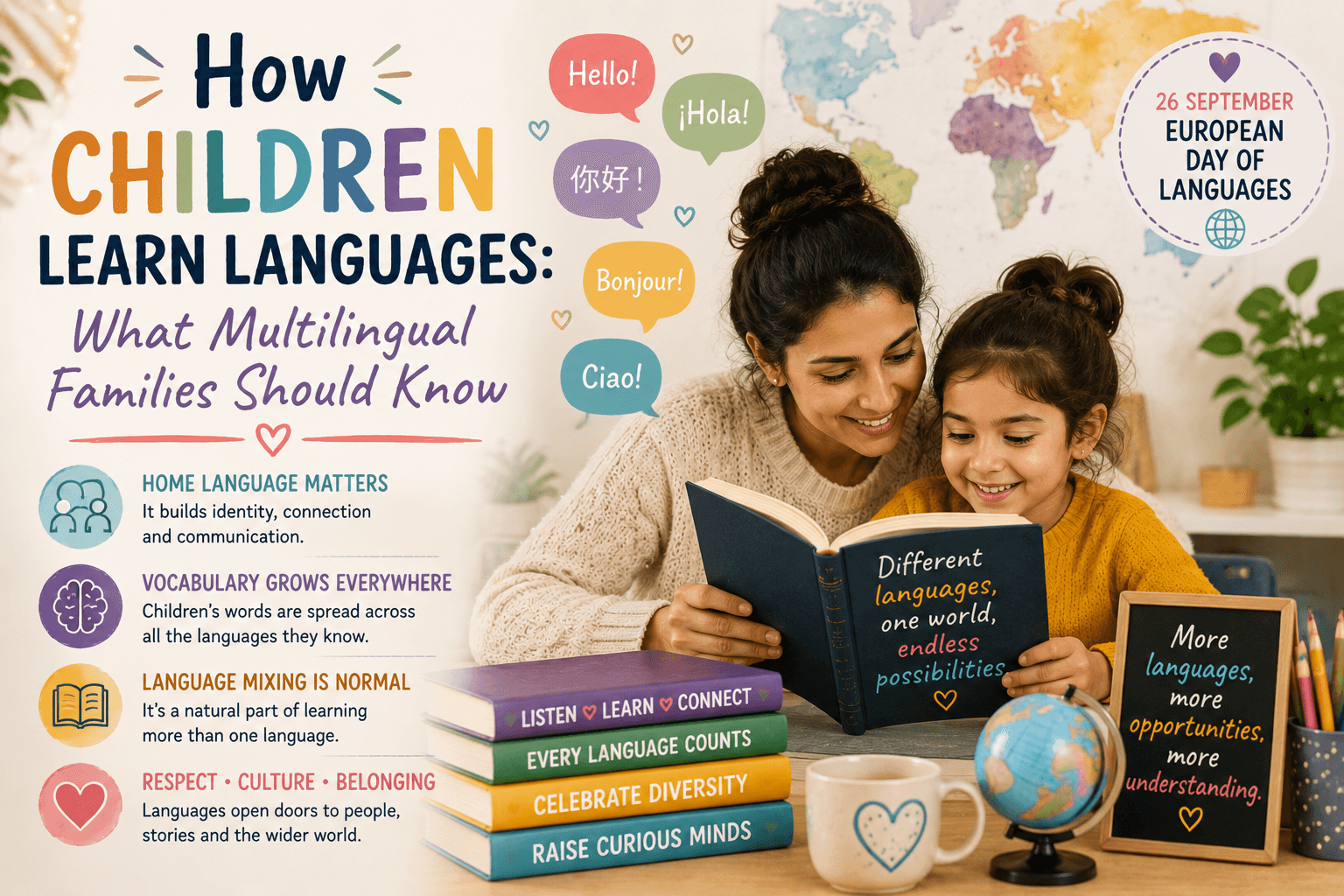
Every year on 26 September, the European Day of Languages celebrates linguistic diversity and encourages language learning across Europe.
For multilingual families, however, language is not something that exists only in lessons. It exists around the dinner table. In conversations with grandparents. In family jokes that do not translate quite properly into English. In songs, expressions, stories and phrases children hear from birth. It can connect a child to relatives living thousands of miles away, to a culture, to a history and to a part of their identity that might otherwise become increasingly distant. I understand some of this personally.
I did not learn English until I was seven years old. The language I grew up speaking is a dialect of Punjabi that does not even have its own written form. For a long time, I did not necessarily appreciate what I had. When you are growing up, speaking a language that is different from the dominant language around you can sometimes feel more like something that makes you different than something valuable. Now, I feel very differently.
I am incredibly glad that I can speak my home language so well. I can communicate with family members. I understand conversations, humour and expressions that would lose something in translation. I have access to a part of my heritage through language. And rather ironically, as an adult, I now wish I spoke more languages. Learning additional languages is something I would eventually love to do. Perhaps that is partly why I find children's language development so fascinating. Because multilingualism is sometimes approached as though children are carrying an additional educational burden. Parents worry:
Will two languages confuse my child?
Should we stop speaking our home language so they learn English faster?
Why are they mixing languages in the same sentence?
Will speaking another language affect their reading?
The evidence gives multilingual families considerable reason for reassurance. Children are capable of learning more than one language. And maintaining a home language can give them something much greater than another set of vocabulary words. It can give them communication, connection, culture and belonging.
Children Are Remarkable Language Learners
Long before children understand grammar terminology, they are discovering extraordinarily complicated patterns in language. A baby hears streams of sounds. Gradually, those sounds begin to carry meaning. They recognise familiar voices. Words emerge. Then combinations of words. Sentences. Questions. Stories. Children begin learning which sounds belong to their language, how words are ordered, how meaning changes according to context and how communication works between people.
Much of early spoken-language development happens through interaction. Someone speaks. The child responds. Someone points. The child looks.The child attempts a word. The adult reacts. Language is social. For multilingual children, that learning environment simply contains more than one linguistic system.
Does Hearing Two Languages Confuse Children?
This remains one of the most persistent concerns among multilingual families. The short answer is: No, exposure to more than one language does not inherently confuse children.
Children around the world grow up learning two or more languages successfully. They can gradually recognise that different languages are used by different people, in different settings or for different purposes. A child might speak one language with their grandparents and another with friends. They may hear one language from Mum and another from Dad. They may use their home language inside the house and the community language elsewhere. And these patterns do not need to be perfectly rigid. Multilingual development can be extremely flexible.
What About Mixing Languages?
A multilingual child might say something like: "Can I have the pani?" using the Punjabi word for water inside an English sentence. Adults sometimes interpret this as evidence that the child cannot separate the two languages. But language mixing, often discussed in relation to code-switching or translanguaging, can be a completely natural feature of multilingual communication. Sometimes a child knows the word they want in one language but not the other. Sometimes one word comes to mind more quickly. Sometimes they are speaking with somebody who understands both languages. And sometimes a particular expression simply feels more natural in one language.
Multilingual adults do this too. In my own experience, there are things I would naturally say in Punjabi that I would never phrase in quite the same way in English. There are jokes that work better. Expressions that carry a particular feeling. Ways of addressing family members that do not translate neatly. That is not linguistic confusion. It demonstrates something much more interesting: languages do not always exist in perfectly separate boxes inside our lives.
A Multilingual Child's Vocabulary Can Look Different
Vocabulary can also cause unnecessary concern. Imagine an English-speaking child knows: dog, cat, apple, water, house, car in English. A multilingual child might know: dog, cat and car in English, but apple, water and house primarily in their home language. If we assessed only their English vocabulary, it might appear smaller. But that would not necessarily represent the child's complete conceptual or linguistic knowledge. Their vocabulary may be distributed across languages. As children gain greater exposure to each language, those vocabularies continue developing. This is why context matters when thinking about multilingual language development.
The Home Language Is Not Something Families Need to Abandon
One of the saddest things I hear is a parent wondering whether they should stop speaking their home language because they are worried it might interfere with English. For many families, that can mean giving up the language in which parents communicate most naturally and richly. And language provides far more than vocabulary. Imagine a grandparent who speaks very little English.
If a child loses the family language, what happens to that relationship?
What happens to the stories the grandparent wants to tell?
The family history?
The jokes?
The memories?
The advice?
Language can connect generations. Maintaining a home language can allow children to participate more fully in their own family and cultural life.
I Understand This Differently Now Than I Did as a Child
My own feelings about language have changed considerably. As a child, I did not necessarily recognise being able to speak Punjabi as something special. English was the language I needed for school and the wider environment around me. When one language dominates education, media and public life, it is easy for children to begin seeing that language as somehow more important.
My Punjabi dialect also has no written form of its own. That means my relationship with it is overwhelmingly oral. It exists in voices, conversations, family, memory, expressions. And that has made me appreciate something that education can sometimes overlook: a language does not need a textbook, spelling test or written literature to have value.
Today, I am grateful that I retained it. I am glad I can speak it confidently. And rather than wishing I had spoken less Punjabi growing up, I now find myself wishing I had learned even more languages. One day, I hope I will. That shift in perspective is one reason I think multilingual families should feel proud of what they are giving their children.
Does a Home Language Affect Learning to Read English?
This requires a little more nuance. Speaking a language and learning to read a language are related, but they are not identical processes. A child can have sophisticated spoken language while still needing explicit instruction in how a writing system works. When children learn to read English, they need to understand how English phonemes relate to graphemes. That means learning the alphabetic code.
A multilingual child may therefore be highly competent in their home language while still being a beginning reader in English. Those things are not contradictory. Likewise, a child may speak English fluently but still struggle with decoding. We should avoid assuming that every reading difficulty experienced by a multilingual child is caused by multilingualism.
Phonological Awareness Can Cross Language Boundaries
Before and during early reading development, children become increasingly aware that spoken language contains smaller units of sound. They notice: rhymes, syllables, beginning sounds, and eventually individual phonemes. These sound-awareness skills are important when learning alphabetic writing systems. Multilingual children may also begin noticing fascinating differences between their languages.
Does this sound exist in both languages?
Does one language use sounds the other does not?
Why is a name pronounced differently by different speakers?
These observations can create valuable conversations about how language works.
But Different Languages Have Different Writing Systems
Multilingual literacy becomes particularly interesting when children learn to read in more than one language. Some languages use alphabetic systems. Others use different scripts or represent language in different ways. Even languages using similar alphabets may have very different relationships between letters and sounds. Children therefore need to learn the conventions of each written language rather than assuming reading works identically everywhere. Children can compare: scripts, letter forms, direction of writing, sounds, punctuation and spelling conventions. Language learning becomes linguistics.
Don't Correct Every Sentence
When children are learning language, adults naturally want to help. But constant correction can make conversation exhausting. Imagine trying to explain something interesting while somebody interrupts every few seconds to correct your grammar. Children need accurate language models, but those models can often be provided naturally. If a child says: "Yesterday I goed to the park." an adult might respond: "Yes, you went to the park yesterday. What did you do there?"
The adult has modelled the conventional form went without stopping the conversation to turn it into a grammar test. Meaning remains central. This can be particularly useful when children are developing more than one language.
Keep Talking, Even If Children Answer in Another Language
This situation is common in multilingual families. A parent speaks the home language. The child understands perfectly. But they answer in English. Parents sometimes conclude: "They don't want the language anymore." Not necessarily. Understanding a language and producing it confidently are different things. The child's receptive language may be stronger than their expressive language. If maintaining the home language matters to your family, continuing to speak it gives the child ongoing exposure to: vocabulary, grammar, pronunciation, expressions, and conversational patterns. You can encourage responses without turning every family conversation into a language lesson.
Relationships Give Languages a Reason to Exist
Children are more likely to use a language when the language has a meaningful purpose.
"Practise Punjabi because it's good for you" is quite abstract.
"Tell Grandma what happened today" gives the language a reason.
So does: talking to cousins, watching something together, singing songs, cooking with a relative, visiting another country, playing with other children who speak the language, or listening to family stories. Language becomes something children use, rather than something they merely study.
Multilingualism and Identity
Language can become deeply connected to identity. It can tell children something about: where their family came from, who their relatives are, which communities they belong to, and how generations before them communicated.
This does not mean children should be forced to define themselves through a particular language. Identity is personal and develops over time. But preserving access gives children a choice. A child may not appreciate their heritage language at eight. At eighteen, twenty-eight or forty-eight, they may feel very differently. I certainly do. That is one reason maintaining a family language can be such a gift. Children may one day value something they cannot yet fully appreciate.
Home Education Can Create Opportunities for Languages
Home-educating families have considerable flexibility. Language learning does not have to happen in a 30-minute lesson followed by a worksheet. It can become part of everyday life. Try: labelling objects around the house, cooking from another country, learning a song, watching a familiar programme in another language, reading bilingual books, writing to a pen pal, exploring children's stories from another culture, learning phrases before travelling, or comparing how several languages express the same idea. Children can investigate where languages are spoken and why. Now language learning connects with: geography, history, culture, migration and identity.
Worldschooling Makes Language Learning Real
For world schooling families, language can become one of the richest parts of travel. Even learning a few phrases before visiting a country changes the experience.
Hello.
Please.
Thank you.
Goodbye.
How much?
Where is...?
Children begin noticing signs. Menus. Announcements. Place names. They hear sounds they may never have encountered before. They discover that millions of people experience everyday life through a language different from their own. This can develop linguistic curiosity as well as cultural awareness. And importantly, it teaches children that English is not the default language of the world. It is one language among thousands.
Language Learning Also Teaches Children to Be Beginners
There is something humbling about learning another language. You know exactly what you want to say. And suddenly you cannot say it. You forget a word. Mispronounce something. Construct a terrible sentence. Need someone to repeat themselves. For children and adults this can be an important learning experience. It requires: persistence, memory, listening, risk-taking and willingness to make mistakes.
It can also build empathy for people communicating in a language that is not their strongest. Someone speaking imperfect English may have sophisticated ideas they simply cannot yet express as fluently in English. Language ability should never be confused with intelligence.
A Simple European Day of Languages Activity
For European Day of Languages on 26 September, choose several European languages and investigate them together.
You could explore:
where each language is spoken,
how to say hello,
how to say thank you,
how numbers 1–10 sound,
whether the writing system is familiar,
words that resemble English words,
sounds English does not commonly use,
and whether anyone in your family or community speaks the language.
Then include your own family languages. Put them on the same map. Talk about where they came from. Ask grandparents or relatives for words, expressions or stories. If your family speaks a dialect rather than a standardised written language, include that too. It still belongs on the linguistic map of your family.
What Multilingual Families Should Remember
There is no single perfect formula for raising multilingual children. Every family is different. One-parent-one-language works beautifully for some families and is completely impractical for others. Some children use different languages depending on location. Some understand a heritage language but rarely speak it. Some learn to read in several languages. Others have a home language that, like mine, may not have a written form available to them. What matters is creating rich, meaningful opportunities for language. Connect children with people who speak the language.