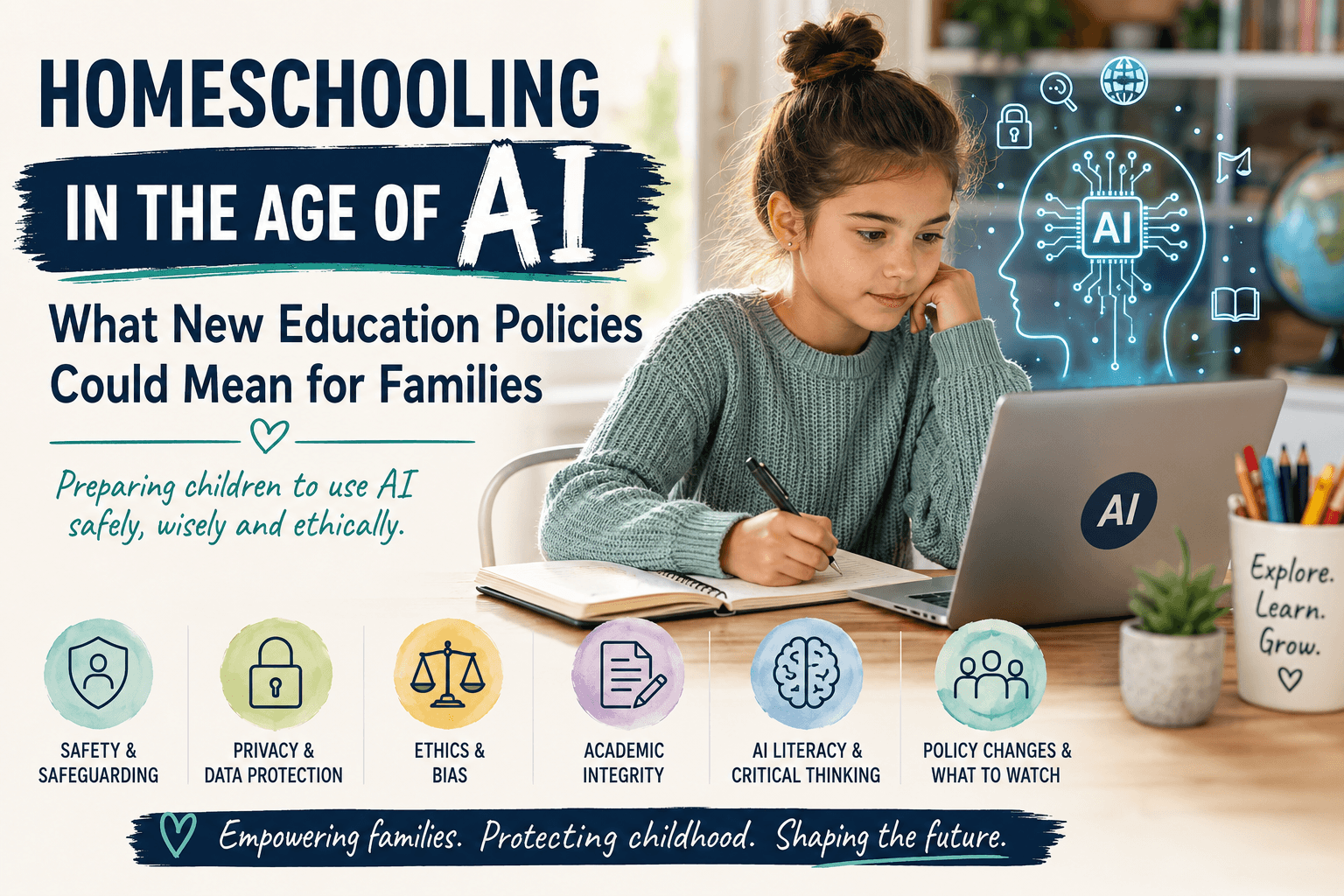
Artificial intelligence is no longer something that belongs to a distant technological future. Children can already use AI to explain a difficult concept, generate ideas for a story, translate a language, create an image, summarise information, practise questions, write computer code or receive instant feedback on their work. For home-educating and world schooling families, the possibilities are particularly significant. A family travelling through Italy could use AI to help explore the history of Rome. A child interested in space could ask questions far beyond the limits of a textbook. A teenager studying independently could use an AI tool to help break down a difficult mathematics problem. Parents could use AI to generate discussion questions, adapt activities or find different ways of explaining a concept.
But the same technology can also produce incorrect information, reproduce bias, collect personal data, generate entire assignments for children and potentially remove some of the thinking that learning is supposed to develop. Governments and education organisations around the world are therefore facing a new question: How do we prepare children for a world in which AI is everywhere without allowing AI to replace the learning children need to do for themselves?
In 2026, that conversation is moving rapidly from experimentation towards policy, regulation, safeguarding and AI literacy. For home educators and worldschoolers, this matters even when policies have been written primarily for schools. Because the bigger question is not simply whether children will use AI. Increasingly, it is how they learn to use it well.
AI Is Already Changing Education
The first major change is philosophical. For several years, much of the education debate focused on whether AI should be allowed at all. That question is becoming increasingly unrealistic. In March 2026, Ofqual described AI tools as part of daily life for many young people and published resources specifically addressing AI use in coursework. Rather than treating every interaction with AI as inherently unacceptable, the focus is increasingly on where its use is appropriate, when it must be disclosed and when it becomes academic malpractice. (GOV.UK)
The Department for Education has also continued developing AI guidance and training for schools and colleges. Its materials emphasise using AI alongside professional expertise rather than treating technology as a substitute for teachers. (GOV.UK) Meanwhile, internationally, UNESCO has called for a human-centred approach to generative AI in education, with particular attention to privacy, age-appropriate use, ethics and meaningful human involvement. (UNESCO) The direction is becoming clearer. AI is unlikely to disappear from education. The challenge is teaching children how to live and learn alongside it.
AI Literacy May Become as Important as Digital Literacy
For years, children have been taught digital skills or IT (what I learnt). They learn how to search online, create documents, communicate digitally and navigate websites, more recently we started teaching coding. AI introduces another layer. Knowing how to type a question into an AI system is not AI literacy. A genuinely AI-literate child needs to understand questions such as:
What is artificial intelligence actually doing?
Where might its information come from?
Can an AI answer be wrong?
How can I verify what it tells me?
What information should I never give an AI system?
Could an answer contain bias?
When is AI helping me learn?
When is it doing my thinking for me?
When should I acknowledge that I have used it?
When would using AI be dishonest?
These are educational questions as much as technological ones.
In June 2026, the European Commission and OECD presented a new AI Literacy Framework for primary and secondary education, designed to help education systems prepare young people to engage with AI confidently and responsibly. (European Education Area) UNESCO's student AI competency framework similarly identifies four broad dimensions: a human-centred mindset, ethics, understanding AI techniques and applications, and AI system design. Crucially, it emphasises critical judgement rather than passive use of AI-generated information. (UNESCO)
For home educators, this creates an interesting opportunity. You do not necessarily need an entirely separate subject called AI. AI literacy can become part of critical thinking, research, digital citizenship and everyday learning.
The Most Important AI Skill May Be Knowing When It Is Wrong
Generative AI can sound extraordinarily confident. That does not mean it is correct. An AI-generated explanation can be beautifully written and completely inaccurate. For children, this creates a particular challenge. Traditional internet literacy often teaches children to consider the source.
Who wrote this?
Which organisation published it?
When was it written?
What evidence supports it?
Generative AI can obscure that process because it produces a single, polished response. Children therefore need to learn a crucial habit: AI output is something to evaluate, not something to automatically believe. Try turning this into a learning activity. Ask AI a question about something your child is studying. Then investigate the answer.
Which claims can you verify?
Can you find a reliable primary or authoritative source?
Has the AI missed important context?
Does another source disagree?
Can your child identify an unsupported claim?
Suddenly AI is not replacing critical thinking. It is becoming material for critical thinking.
What Does This Mean for Younger Children?
This distinction becomes particularly important in early education. A five-year-old learning to blend sounds does not need AI to blend the word for them. A seven-year-old learning to write sentences needs opportunities to formulate sentences. A child developing number sense needs opportunities to think about quantity, relationships and mathematical strategies. If technology constantly removes the difficult part of the task, children may produce better-looking work without developing the underlying skill. Completing a task is not necessarily the same as learning from it.
AI might help a parent think of five words containing a particular phoneme. It could generate ideas for a science investigation. It could suggest questions for a history discussion. But the child still needs to read, think, remember, retrieve, explain, practise and create. AI should support those processes rather than quietly replace them.
AI and Cognitive Development
This issue is increasingly appearing in policy too. England's Department for Education updated its generative-AI product safety standards in January 2026 to include additional standards relating to cognitive development, emotional and social development, mental health and manipulation. (GOV.UK) That is significant. It recognises that evaluating educational AI cannot simply mean asking: Does the technology work? We also need to ask: What happens to the child when they use it?
Does it encourage independent thought?
Does it create dependency?
Does it provide inappropriate advice?
Does it attempt to influence behaviour?
Does it replace meaningful interaction?
Does it support development—or shortcut it?
For parents choosing educational technology, these questions may become increasingly important.
Privacy: What Are Children Telling AI?
One of the biggest policy concerns surrounding AI and children is data. AI tools may process information users enter into them. That becomes particularly important when children are involved. A child might innocently enter:
"My name is..."
"I live at..."
"My teacher said..."
"My diagnosis is..."
"Here is a photograph of me..."
"Here is my school report..."
For a young learner, there may be little understanding of where that information goes or how a digital service processes it. The Department for Education's data-protection guidance warns schools to consider how personal data is protected when generative AI is used and specifically highlights risks involving personal information and bias. The guidance was updated again in July 2026. (GOV.UK) UNESCO has likewise identified privacy—particularly children's privacy—as one of the central concerns surrounding generative AI in education. (UNESCO)
What can home-educating families do?
A simple family rule can help: Don't put personal or sensitive information into an AI tool unless you understand how that information will be handled. Before allowing a child to use a particular service, parents should consider its age requirements, privacy policy and data controls. For younger children especially, adult-guided use is preferable to unrestricted independent access.
Safeguarding Doesn't Disappear Because Learning Happens at Home
Schools operate within formal safeguarding frameworks. Home education is different. Parents are responsible for choosing many of the websites, apps, online tutors and digital environments their children encounter. AI adds another layer. Some systems allow open-ended conversations. Others generate images or characters. Some can simulate relationships or respond to highly personal questions. That means families need to think beyond traditional ideas of "screen time".
The question isn't simply: How long is my child online? It is also: What kind of interaction are they having while they are there?
UNESCO's guidance recommends age-appropriate approaches to generative AI and argues for safeguards around independent interactions between children and AI systems. (UNESCO) In England, the wider safeguarding environment is also tightening. Keeping Children Safe in Education 2026 comes into force on 1 September 2026 for schools and colleges, while DfE materials on AI repeatedly link safe implementation with existing safeguarding expectations. (GOV.UK) Those statutory duties do not simply transfer to a parent educating their own child at home. But the underlying principle remains valuable: new technology should not be introduced without considering children's safety.
AI and Academic Integrity
For older home-educated and worldschooling students, academic integrity is another major consideration. Imagine a teenager is asked to write an essay. They ask AI to suggest three arguments.
Is that cheating?
What if they ask it to correct their grammar?
What if it rewrites a paragraph?
What if it produces the entire essay?
There is no single answer that applies to every educational context. But where children are working towards formal qualifications, the rules of the awarding organisation matter. Ofqual's 2026 resources make clear that using AI to generate coursework without appropriate disclosure can constitute cheating and can carry serious consequences, potentially including the loss of a qualification. (GOV.UK) For home-educated students preparing for GCSEs, A levels or other assessed qualifications, this is particularly important. A family may have a relaxed approach to AI during everyday learning while still needing strict boundaries around formally assessed work. Children need to understand the difference.
Teach the Difference Between Learning and Producing
AI exposes a problem that existed long before AI. Education can become overly focused on the finished product.
Did you complete the worksheet?
Did you write the essay?
Did you get the answer?
Did you finish the project?
But learning happens in the process. Consider two children asked to write a paragraph explaining photosynthesis. One struggles for fifteen minutes, checks a book, changes their wording, makes a mistake, corrects it and eventually produces an imperfect paragraph. Another asks AI to generate an excellent paragraph and copies it. The second piece of work may look better. But which child learned more?
This is one of the most important conversations families can have about AI. The goal of education isn't simply to produce impressive work. The goal is to develop the person capable of producing, questioning and understanding that work.
A Useful Family Question: "What Is the Learning Here?"
Before using AI, ask:
What is the learning objective?
If your child is learning spelling, AI shouldn't spell every word for them.
If they are learning writing, AI shouldn't write the paragraph.
If they are learning research skills, they shouldn't receive every conclusion without examining sources.
If they are learning mathematical reasoning, an instant answer may remove the reasoning.
But if the objective is understanding a difficult scientific idea, asking AI for a simpler explanation might be useful.
If the objective is practising French conversation, an AI interaction might provide additional practice.
If the child has already written something and wants feedback, AI might help identify areas to reconsider.
The same technology can either support learning or undermine it depending on how and why it is used.
AI Could Be Particularly Powerful for Home Education
There are genuine opportunities here. Home education is often highly individualised. Families can follow children's interests, adjust pacing and explore subjects in greater depth. AI can complement that flexibility. A parent might use it to:
generate discussion questions,
suggest project ideas,
adapt explanations,
create practice questions,
explore opposing arguments,
suggest experiments,
generate vocabulary,
brainstorm writing prompts,
help structure a learning plan,
or identify further topics to investigate.
A child fascinated by Ancient Egypt could move from pyramids to engineering, geometry, archaeology, hieroglyphics, mythology and geography within one afternoon. AI can help parents follow those connections quickly. But it should ideally be the starting point for exploration, not the final authority.
What About Worldschooling?
For worldschooling families, AI may be even more transformative. Learning already happens across countries, cultures, languages and environments. AI tools can potentially help families:
translate unfamiliar language,
understand local customs,
research historical sites,
create location-based learning activities,
compare cultures,
identify local wildlife,
plan museum questions,
explore geography,
or provide explanations while travelling.
Imagine visiting the Colosseum and asking your child: "What do you want to know?" Their questions can guide an entire day's learning. AI can help parents respond quickly but then the real world can provide the evidence. Read the museum information. Talk to a guide. Look at the architecture. Find a reliable historical source. Compare what you discover with what AI told you. That is where worldschooling and AI can work beautifully together. Technology can open the question. The world can become the classroom.
But AI Could Also Widen Educational Inequality
There is another side to the discussion. Not every child has equal access to:
reliable internet,
suitable devices,
paid AI systems,
digitally confident adults,
high-quality online education,
or the knowledge required to evaluate AI outputs.
UNESCO has warned that digitalisation and AI can create opportunities while also worsening existing inequalities and raising concerns around access, bias, ethics, privacy and inclusion. (UNESCO) If AI literacy becomes an expected educational skill, access to safe and effective AI education cannot simply depend on a family's income or technological confidence. For home educators, this is also worth remembering. AI is a tool not a prerequisite for a good education. Children can still receive rich, rigorous education through books, conversation, practical experiences, nature, libraries, museums, writing, mathematics, creativity and human relationships.
What About Bias?
AI systems learn patterns from enormous quantities of existing material. That material reflects the world humans have created—including its biases, inequalities and cultural assumptions. UNESCO has repeatedly identified bias, cultural and linguistic diversity, ethics and inclusion as important issues in AI-enabled education. (UNESCO) This creates another valuable learning opportunity. Ask children: Whose perspective might be missing?
If you ask AI about an historical event, does the answer change depending on how the question is phrased?
Are certain countries or cultures represented more extensively than others?
Does the system handle less widely spoken languages as effectively?
Rather than pretending technology is neutral, children can learn to question the systems they use. That is sophisticated digital literacy.
AI Should Not Replace Human Relationships
There is another part of education that can easily be overlooked. Children do not simply learn information. They learn through relationships.
A parent notices when a child is confused even though they say they understand.
A teacher knows when to challenge and when to slow down.
A sibling turns a maths activity into a conversation.
A museum guide tells a story that sparks a lifelong interest.
A friend disagrees.
A child learns to explain their reasoning.
Education contains empathy, humour, frustration, encouragement, negotiation, curiosity and shared experience. AI can simulate aspects of conversation. It cannot replace the full richness of human relationships. UNESCO's approach has consistently argued that AI should complement rather than displace the human elements of teaching and learning. (UNESCO) For home education, this principle is especially important. One of the greatest strengths of home education can be the ability to build learning around relationships, conversation and real experiences. AI should expand those opportunities, not shrink them.
What Could an AI-Aware Home Education Look Like?
Families do not need a 40-page AI policy. A few clear principles may be more useful.
1. Learn before you automate
Children should develop foundational skills rather than immediately outsourcing them.
2. Think first, ask AI second
Encourage children to attempt a question, form an opinion or generate ideas before requesting assistance.
3. Verify important information
Use reliable sources rather than treating AI as the source.
4. Protect personal information
Teach children not to share unnecessary personal or sensitive information with AI systems.
5. Follow age restrictions
Different platforms have different rules and safeguards. Check them before allowing independent access.
6. Be transparent
If AI contributed significantly to a piece of work, children should learn when and how that use needs to be acknowledged.
7. Keep assessed work separate
Qualification work may have specific AI rules. Follow the requirements of the awarding body.
8. Preserve human learning
Reading books, handwriting, discussion, practical investigation, creative play, outdoor learning and face-to-face interaction remain valuable.
9. Question AI
Ask: How do we know?
10. Use AI intentionally
Don't use technology simply because it exists. Use it when it genuinely improves the learning experience.
The Policy Direction Families Should Watch
There is not yet one universal global rule governing children's use of AI in education. Different countries are developing different approaches. But several common themes are emerging:
AI literacy - Children increasingly need to understand AI rather than simply use it.
Privacy - Children's personal data requires particular protection.
Safeguarding - AI products used with children need age-appropriate protections.
Human oversight - Adults remain important in deciding when and how technology should be used.
Academic integrity - Education systems are developing clearer boundaries around acceptable AI assistance.
Critical thinking - Children need the skills to challenge AI-generated information.
Equity - Governments need to consider who benefits from AI and who risks being left behind.
The European AI Literacy Framework, UNESCO's competency work and England's evolving education guidance all point towards a future in which responsible AI use becomes part of education itself, rather than being treated solely as a technology issue. (European Education Area)
Does This Mean Home Educators Will Have to Teach AI?
At present, home educators should be careful not to confuse guidance written for schools with legal duties applying to home education. For example, England's DfE AI training materials are specifically designed for schools and colleges. They do not create a new statutory AI curriculum that every home-educating parent must follow. (GOV.UK) However, there is a broader educational question. Even where families are not legally required to teach AI literacy, children are growing up in a world increasingly shaped by AI. Understanding it may therefore become an important part of preparing children for:
further education,
employment,
research,
digital citizenship,
media literacy,
and adult life.
The question for home educators may eventually become less: "Do I have to teach this?" and more: "What does my child need to understand to navigate this world confidently?"
What Should Parents Do Now?
There is no need to panic and no need to turn every child's education into an AI curriculum. Start with conversation. Ask your child what they already know about AI. Find out which tools they encounter. Talk about where AI can be useful and where it can be unreliable. Teach them that fluent writing does not guarantee factual accuracy.
Discuss privacy.
Discuss authorship.
Discuss what cheating means.
Most importantly, keep asking: "What are you learning by using this?"
That question can guide many of the decisions that follow.
Artificial intelligence will almost certainly change education. But that does not mean the fundamental purpose of education has changed. We still want children who can:
read carefully,
write clearly,
reason mathematically,
evaluate evidence,
ask good questions,
solve problems,
communicate with others,
create original ideas,
recognise when they don't know something,
and continue learning throughout their lives.
AI can support many of those things. Used poorly, it can also allow children to bypass them. That is why the most important conversation about AI in education isn't really about technology. It is about learning. For home-educating and worldschooling families, there is an opportunity here. You have the flexibility to introduce AI thoughtfully, to experiment, to question it alongside your children and to decide when technology genuinely adds something to an experience. Children should not be taught to fear AI. Nor should they be taught to trust it unquestioningly. They need something much more valuable: the knowledge to understand it, the judgement to question it and the confidence to know when their own thinking matters more. Because preparing children for an AI-powered world does not mean handing their education over to AI. It means preparing them to remain capable, curious and independent thinkers within it.
For families who want to explore the policy direction further, the European Commission's AI Literacy Framework announcement, UNESCO guidance on generative AI in education and Department for Education guidance on AI and data protection provide useful starting points.